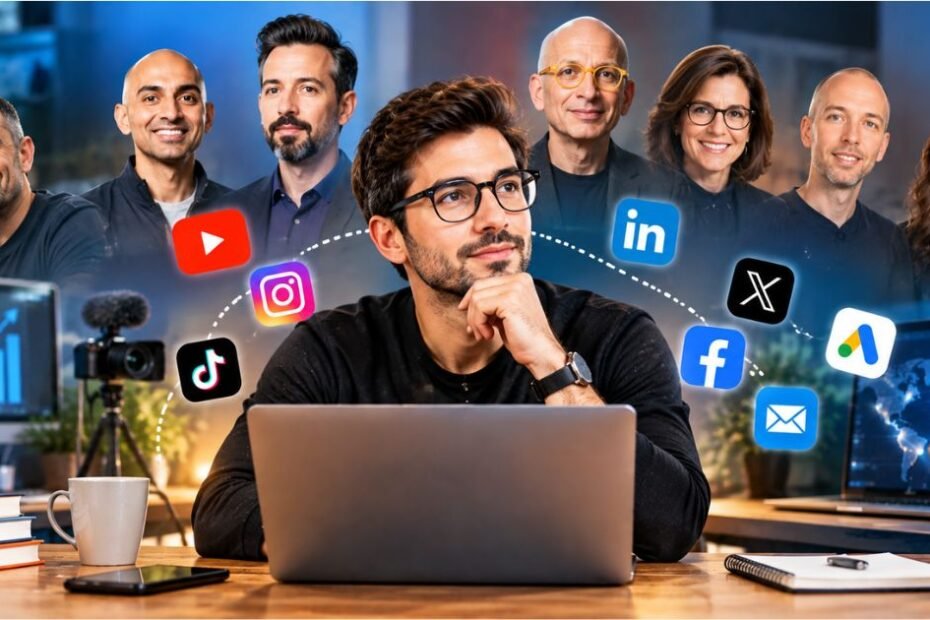
Digital marketing changes fast but the people worth learning from don’t change as often as you’d think. The top 10 digital marketing gurus in 2026 are Neil Patel, Gary Vaynerchuk, Rand Fishkin, Ann Handley, Jay Baer, Brian Dean, Mari Smith, Paul Roetzer, Kim Garst, and Neal Schaffer. Each one builds a career on a different specialty: SEO, content, AI, social, or conversion so the “best” one for you depends on what you’re trying to fix.
Below, you’ll find who they are, what they’re actually known for, and how to tell a real guru from someone who just has a big following.
What Makes Someone a Digital Marketing Gurus in 2026?
A digital marketing gurus is someone who has built and proven a marketing method not just talked about one. Real gurus share three things: a track record of results they can point to, a framework or technique other marketers can actually use, and a body of public work (books, tools, or content) that holds up under scrutiny.
Followers alone don’t make someone a guru. A large audience without a repeatable method is an influencer, not an expert. The people on this list all pass a simple test: could you take their specific method and apply it to your own business today? If yes, they earned their spot.
The Top 10 at a Glance
| # | Guru | Known For |
| 1 | Neil Patel | SEO & content-driven customer acquisition |
| 2 | Gary Vaynerchuk | Personal branding & platform-native content |
| 3 | Rand Fishkin | SEO & audience research |
| 4 | Ann Handley | Content marketing & brand writing |
| 5 | Jay Baer | Customer experience & word-of-mouth marketing |
| 6 | Brian Dean | Link building & SEO systems |
| 7 | Mari Smith | Facebook & Meta advertising |
| 8 | Paul Roetzer | AI in marketing |
| 9 | Kim Garst | Social selling & AI-driven engagement |
| 10 | Neal Schaffer | Social media strategy & influencer marketing |
The Top 10 Digital Marketing Gurus, Ranked
1. Neil Patel
Neil Patel built his reputation on SEO, content marketing, and turning search data into practical business advice. As co-founder of NP Digital and the free tool Ubersuggest, he’s spent over a decade helping businesses translate keyword research into real traffic growth.
What sets Patel apart is volume and consistency; he publishes SEO audits, case studies, and strategy breakdowns across his blog, YouTube, and podcasts almost daily. If you want a steady stream of tactical, numbers-first SEO advice, he’s the most reliable source on this list. If you want the same kind of tactical grounding for your own site, our How to Increase SEO Ranking: 2026 Framework + Checklist follows a similar numbers-first approach.
Follow him for: step-by-step SEO and content strategy you can apply the same day you read it.
2. Gary Vaynerchuk
Gary Vaynerchuk “Gary Vee” built VaynerMedia around one idea: create content natively for each platform instead of repurposing the same post everywhere. He was early to Facebook, early to Instagram, and early to TikTok, and his advice usually centers on speed and adaptation over polish.
His books, including Day Trading Attention and Crushing It!, focus on personal branding and paying attention to where audience attention is shifting next. He’s less about formulas and more about instinct, useful if your business depends on staying culturally current. For a more structured starting point on platform-native content, our What Is Social Media Marketing? Complete Beginner Guide covers the fundamentals Vaynerchuk’s instinct-driven approach builds on.
Follow him for: early signals on which platforms and formats are about to matter.
3. Rand Fishkin
Rand Fishkin co-founded Moz, one of the tools that shaped modern SEO practice, then founded SparkToro, which helps marketers figure out where a specific audience actually spends its time and attention. His work leans heavily on transparency he writes openly about failures alongside wins, which is rare in marketing content.
His book Lost and Founder covers the harder realities of company-building, and his current focus on audience research reflects a shift from “rank for keywords” to “understand your actual audience first.” Our 6 Ways to Improve Your Site’s SEO Rankings covers several of the same audience-first fundamentals Fishkin emphasizes.
Follow him for: honest, data-backed audience research over hype.
4. Ann Handley
Ann Handley is the person most marketers point to when they talk about writing that doesn’t sound like generic brand copy. As Chief Content Officer at MarketingProfs, her work treats word choice, tone, and specificity as part of the customer experience, not decoration on top of it.
Her bestselling book Everybody Writes is a practical guide to better blog posts, emails, and social content. If your team’s writing feels interchangeable with every competitor’s, her frameworks are the fix.
Follow her for: content that sounds like a person, not a template.
5. Jay Baer
Jay Baer’s core idea, which he calls “Youtility,” is that marketing works best when it’s genuinely useful enough that people seek it out on their own. As founder of Convince & Convert, he’s built a career around customer experience, word-of-mouth, and content that answers questions before making a sales pitch.
His books Hug Your Haters and Talk Triggers give concrete frameworks for turning customer service into a growth channel.
Follow him for: customer experience and retention strategy, not just acquisition tactics.
6. Brian Dean
Brian Dean built Backlinko around repeatable, documented SEO processes, most famously the Skyscraper Technique, a method for finding link-worthy content, building something stronger, and promoting it directly to the right publishers. After selling Backlinko to Semrush, he launched Exploding Topics to help marketers spot emerging search trends early.
His content is dense with case studies and real search-result examples rather than general advice, which makes it easier to replicate. That same case-study-backed approach to link building and topical depth is central to how we cover Topical Authority Google Ranking Ka Powerful Formula.
Follow him for: step-by-step, case-study-backed SEO tactics.
7. Mari Smith
Mari Smith, often called the “Queen of Facebook,” has spent her career specializing almost entirely in Facebook and Meta advertising, organic reach, and community building. She’s worked directly with Meta as a trainer, which gives her insight into algorithm changes before most marketers see the impact.
If your business runs meaningful ad spend or community engagement on Facebook or Instagram, she’s the most focused resource available. Once you’re ready to build a broader plan around a platform like Meta, our 10 Steps to Develop a Social Media Marketing Strategy is a useful structural counterpart to her platform-specific advice.
Follow her for: Meta platform changes and how to adapt your strategy fast.
8. Paul Roetzer
Paul Roetzer founded the Marketing AI Institute and created MAICON, the Marketing AI Conference making him one of the clearest voices connecting practical AI tools to actual marketing workflows, rather than just discussing AI in the abstract. His team built a free “AI Score for Marketers” assessment that helps marketers benchmark their AI use against peers.
As AI tools reshape content production, personalization, and campaign optimization, Roetzer is the name most consistently cited by other marketing leaders when the topic turns to AI. He fills a gap most “guru” lists still miss.
Follow him for: how to actually integrate AI into a marketing team’s workflow, not just AI trend commentary.
9. Kim Garst
Kim Garst built her name in social selling and has more recently focused on AI-driven engagement and blockchain-adjacent marketing strategy, alongside three decades of hands-on digital marketing experience. She’s consulted for companies including IBM, MasterCard, and Microsoft, and remains one of the most-followed voices for practical social selling advice. If social selling is a channel you’re building out, our 12 Proven Benefits of Social Media Marketing covers the underlying case for why it works.
Follow her for: turning social platforms into a direct sales channel.
10. Neal Schaffer
Neal Schaffer specializes in social media strategy and influencer marketing, with a particular focus on how brands build lasting relationships with creators instead of treating influencer deals as one-off transactions. His book The Age of Influence frames influencer marketing as a long-term strategic function, not a side channel.
His consulting work for brands like Adobe and Microsoft reflects a consistent theme: connecting social activity to measurable business outcomes.
Follow him for: building an influencer marketing program that isn’t just a series of paid posts.
Digital Marketing Gurus by Specialty
| Specialty | Guru(s) | Best For |
| SEO | Rand Fishkin, Brian Dean, Neil Patel | Organic traffic and search visibility |
| Content Marketing | Ann Handley, Jay Baer | Writing and content strategy that converts |
| Social Media | Gary Vaynerchuk, Mari Smith, Kim Garst | Platform-specific growth and engagement |
| AI Marketing | Paul Roetzer | Workflow automation and AI adoption |
| Influencer Marketing | Neal Schaffer | Creator partnerships and brand collaborations |
If SEO is your priority based on this table, our SEO Services Cost: What Businesses Should Expect to Pay is a useful next read for budgeting around it, and if social media is the priority, our 12 Best Social Media Marketing Tools rounds out the tooling side of what these gurus teach.
Who Is the Most Famous Digital Marketer?

Neil Patel and Gary Vaynerchuk are generally considered the two most famous digital marketers, thanks to their consistent output across blogs, YouTube, and podcasts for over a decade. Patel is best known for SEO and content strategy education; Vaynerchuk is best known for personal branding and early platform adoption. Both built audiences by publishing constantly rather than relying on a single viral moment.
Who Is the Richest Digital Marketer in the World?
Neil Patel is widely cited as one of the wealthiest digital marketers, with third-party estimates placing his net worth around $60 million. That figure comes from public estimates rather than an audited financial disclosure, so it should be treated as indicative, not definitive private entrepreneurs’ net worth is rarely confirmed with hard numbers. Patel’s business portfolio includes NP Digital and Ubersuggest, and he’s been publicly recognized by both a former U.S. president and the United Nations for his entrepreneurship.
How to Actually Learn From These Gurus
Reading a “top 10” list is step one. Actually learning from these people means building a habit around it.
- Pick one specialty first. Don’t try to follow all 10 match the guru to the specific problem you’re solving right now (traffic, content quality, social growth, AI adoption).
- Subscribe to their newsletter, not just their social feed. Newsletters tend to carry deeper, less algorithm-driven insights.
- Listen to their podcasts during downtime. Several of these experts (Baer, Patel, Roetzer) run podcasts that go deeper than any single blog post can.
- Test one framework at a time. Skyscraper Technique this month, Youtility messaging next month don’t try to absorb everything at once.
What Separates a Real Gurus From Hype
Most “top marketing gurus” lists rank by popularity. That’s the wrong metric. The better filter is whether someone’s method survives contact with your actual business.
Here’s a simple way to test any marketing guru before you build your strategy around their advice: can you name one specific technique they teach, and could you execute it this week with the resources you already have? If the answer is no if their content is mostly personality and general motivation they’re an influencer, not a guru. Every name on this list passes that test, because each one attaches their advice to a named, teachable method: Youtility, the Skyscraper Technique, Persuasion Architecture, audience-first SEO. That’s the real differentiator in 2026, when anyone can build a following but far fewer people can hand you something repeatable.
Conclusion
The top digital marketing gurus in 2026 \Neil Patel, Gary Vaynerchuk, Rand Fishkin, Ann Handley, Jay Baer, Brian Dean, Mari Smith, Paul Roetzer, Kim Garst, and Neal Schaffer \each built their reputation on one specific, teachable method, not just an audience. Match the guru to your problem, not to their follower count, and you’ll get more out of following them than any generic “top 10” list can promise.
FAQs
Who is considered the father of digital marketing?
There’s no single agreed-upon “father” of digital marketing, since the field grew out of contributions from early SEO practitioners, email marketers, and web analytics pioneers simultaneously in the late 1990s and early 2000s.
What makes someone a digital marketing guru?
A real guru combines a proven track record, a teachable framework or method, and a consistent public body of work, not just a large social media following.
How do I learn digital marketing from experts for free?
Most gurus on this list offer free content through blogs, YouTube channels, and podcasts Neil Patel’s blog, Brian Dean’s Backlinko, and Paul Roetzer’s Marketing AI Institute newsletter are strong starting points.
Who are the top AI marketing experts in 2026?
Paul Roetzer, founder of the Marketing AI Institute, is the most consistently cited AI marketing expert, focused specifically on practical AI adoption inside marketing teams.
Should I follow a guru who specializes in one channel, or a generalist?
It depends on your goal. If you have a specific, immediate problem (like SEO traffic or Facebook ad performance), a specialist like Brian Dean or Mari Smith will get you further faster than a generalist.
Do these rankings change often?
Yes. Digital marketing shifts with platform algorithms and new technology, so the specific names worth following can shift year to year. AI marketing specifically is a category that barely existed on “top guru” lists three years ago.
