
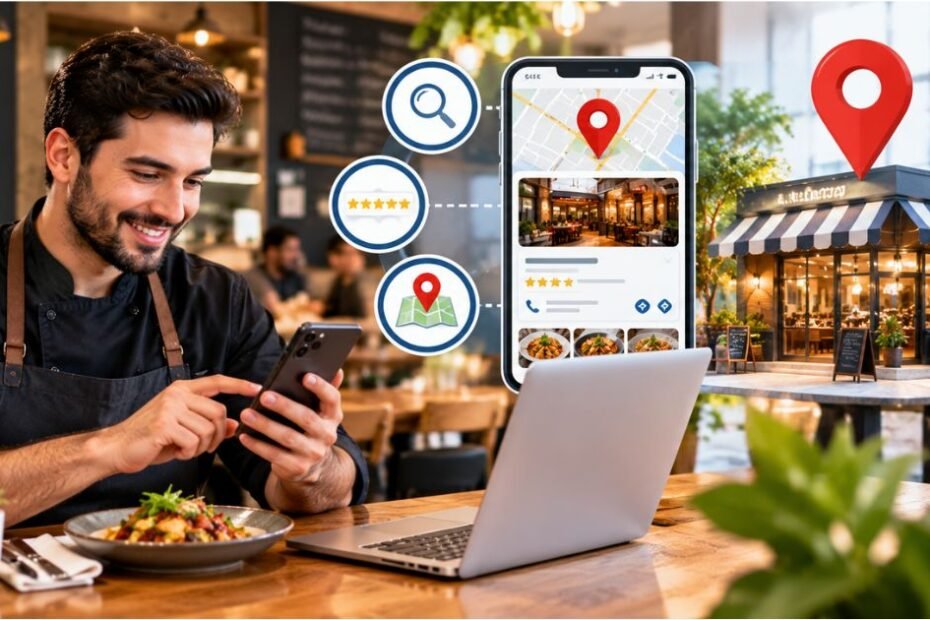
Local SEO puts your restaurant in the map results diners check before choosing where to eat. Why local SEO is a game changer for restaurants is simple: it helps your business appear when nearby diners are actively looking for places to eat. It works through an accurate Google Business Profile, strong recent reviews, and consistent listings. It matters because nearly every diner reads reviews first, and many now ask AI tools for picks. Results are never guaranteed.
What Is Local SEO for Restaurants?
Local SEO for restaurants is the practice of optimizing your online presence so nearby diners find you when they search for a cuisine, a dish, or “restaurants near me.” It centers on your Google Business Profile, your reviews, your website, and how consistently your details appear across the web. Structured data helps search engines and AI assistants read your hours, location, and price range without guessing our guide to Schema Markup for SEO covers exactly how to set this up correctly.
Think of it as your digital storefront sign. The difference is that Google decides who sees it, and it decides in seconds.
Why Local SEO Is a Game Changer: 5 Reasons
1. Diners decide inside the map results
When someone searches for a restaurant nearby, Google shows a map with a short list of businesses before most websites appear. That block is called the local pack (or map pack).
Getting into it means being seen at the exact moment a diner is choosing. Your website can be beautiful, but it won’t matter if the diner never scrolls that far.
2. Reviews decide before you say a word
Here’s the fact that should change how you spend your time. In BrightLocal’s 2026 survey, 97% of consumers said they read reviews for local businesses, and 71% use Google to do it.
And reviews don’t just help you win. They can also make you lose. Of the consumers who rejected a business, 65% did so for a review-related reason: negative reviews, a low rating, or no reviews at all.
For a restaurant, that means a thin or outdated review profile can quietly cost you tables every night.
3. Local searches are urgent and nearby
Someone searching “brunch near me” is not researching. They’re hungry, they’re close, and they want to decide now. That’s why hours, directions, the call button, and the menu on your profile matter so much.
Local SEO puts those details in front of ready-to-act diners, not casual browsers.
4. AI tools now recommend restaurants
This is the newest shift. BrightLocal’s 2026 survey found 45% of consumers use ChatGPT or other generative AI tools for local business recommendations.
It’s also harder to win. SOCi’s 2026 index found visibility in ChatGPT’s local recommendations is 30x harder to achieve than ranking in Google’s local results, and fewer than half of businesses leading Google local results also appear in AI recommendations.
The good news: the fixes overlap. Accurate, consistent business information and strong reviews help you in both places.
5. The gains compound
A new review, a complete profile, and a consistent listing all keep working after you finish them. Paid ads stop when the budget stops. Local SEO keeps building as long as you keep it fresh. Our broader 6 Ways to Improve Your Site’s SEO Rankings covers this same compounding-effort principle beyond just the local angle. (Compare the two using your own numbers, not anyone else’s averages.)
How Does Google Decide Which Restaurants Show Up?
Google says local results are mainly based on three factors: relevance, distance, and prominence. Google also states there’s no way to request or pay for a better local ranking.
| Factor | What it means | What you can do |
| Relevance | How well your profile matches what the person searched | Fill out every field, choose the right category, describe your cuisine clearly |
| Distance | How far you are from the searcher | You can’t move your restaurant, but you can make sure your address is accurate |
| Prominence | How well-known you are | Google ties this to things like how many websites link to you and how many reviews you have. Earn reviews, links, and mentions |
You can only control two of the three. That’s why reviews and profile detail are where restaurants win or lose.
The “Tonight Test”: Audit Your Restaurant in 10 Minutes

Here’s a simple framework you can run today. It shows you what a real diner sees, not what you think they see.
Grab your phone and stand about a mile from your restaurant. Then search these five queries and note where you appear:
- “[your cuisine] near me”
- “best [your cuisine] in [your neighborhood]”
- “[your dish] near me”
- “restaurants open now near me”
- Your restaurant’s exact name
Score yourself:
- Found in the top three for at least three searches: you’re in good shape.
- Found but buried (no photos, thin reviews, wrong hours): fix the profile first.
- Not found for your own name: your listing may be unclaimed or inconsistent. Start there.
If you have before-and-after screenshots from a real restaurant client, this is the place to show them. Real results beat any generic example.
What a Restaurant-Ready Google Business Profile Looks Like
Your Google Business Profile (GBP) is the single most important local asset you own. Here’s what a strong one includes:
- A precise primary category. A pizzeria categorized as “Restaurant” competes with every restaurant in town, while “Pizza Restaurant” competes for “pizza near me” with far less competition.
- Accurate hours, including holidays. Wrong hours send diners to a closed door and a bad review.
- Dining attributes. Options like outdoor seating, “good for groups,” or “serves brunch” can decide whether you appear for filtered searches in Google Maps.
- A current menu and clear order or reservation links.
- Real photos. For restaurants, photos appear in Google’s image carousel for searches like “restaurants near me.” Show your food, your room, and your team.
- Regular updates. Share new dishes, events, and specials.
Also make sure your name, address, and phone number match everywhere else online. Inconsistent details confuse both Google and diners the same consistency principle our Virginia Local SEO guide covers in more depth, even if your restaurant isn’t in Virginia.
How Many Reviews Does a Restaurant Need?
There is no official number. Google has never published a minimum review count for local ranking. But diners have clear preferences, and they’re stricter than most owners expect.
| What diners want | The data |
| Enough reviews | 47% won’t use a business with fewer than 20 reviews. |
| Recent reviews | 74% only care about reviews from the last 3 months, and 32% look for reviews from the last 2 weeks. |
| A response | 80% say they’re more likely to use a business that replies to all its reviews, while generic or templated replies put off half of respondents. |
Two takeaways:
- Recency matters as much as volume. A steady trickle of fresh reviews beats a burst from two years ago.
- Reply like a human. Be specific, warm, and quick.
One honest note on replies: a 2026 expert survey ranked owner responses far down its list of local-pack ranking factors (122nd of 187), while review quantity and recency ranked near the top. So replies may not move your ranking, but they clearly move diners.
Also, don’t rely on Google alone. Google’s usage for reading reviews dropped from 83% to 71% in a year. In the same survey, 37% of consumers used Instagram and 29% used TikTok to find local reviews a sign that your social media marketing presence and your local SEO are no longer separate jobs.
Will ChatGPT and AI Search Recommend Your Restaurant?
Nobody can promise that. AI tools decide with their own systems, and those change. But you can raise your odds.
AI assistants tend to lean on the same signals Google does: your profile, your reviews, your website, and consistent information across the web. A restaurant with conflicting hours on three sites gives an AI good reason to skip it.
Here’s a simple checklist:
- Keep your hours, address, phone, and menu identical everywhere.
- Publish a real, readable menu on your website (not just a PDF or image).
- Add restaurant schema markup so machines can read your details.
- Keep collecting fresh reviews on more than one platform.
- Describe what makes you different in plain words: “wood-fired pizza,” “late-night ramen,” “gluten-free brunch.”
Think of AI visibility as a reward for doing local SEO well, not a separate trick.
Yelp, Apple Maps, TripAdvisor or Delivery Apps: Where to Show Up
You don’t need to be everywhere equally. Here’s how to think about the US mix:
| Platform | Why it matters | Your move |
| Google Business Profile | Where the map pack and most discovery happen | Top priority. Complete and update it |
| Yelp | Still a major restaurant review source | Claim it and keep details accurate |
| Apple Maps | Where iPhone users often search | Claim your listing through Apple Business Connect |
| TripAdvisor / OpenTable | Useful for tourist areas and reservations | Claim it if your guests use it |
| DoorDash / Uber Eats | Convenient, but they own the customer relationship | Keep info accurate, and link people back to your own ordering when you can |
The rule: claim and correct first, expand later. A neglected listing can hurt you more than having no listing at all.
How to Tell If It’s Working
You don’t need a fancy dashboard. Your Google Business Profile shows you the numbers that matter. You can track website visits, direction requests, and phone calls in the performance section of your profile. If you’re also cross-checking that traffic in Google Analytics and Search Console, our comparison of GA4 Sessions vs GSC Clicks explains why those two numbers rarely match and what each one is actually telling you.
Check these monthly:
- Calls and direction requests. These are your closest signals of real visits.
- Website clicks. Are people checking your menu or booking online?
- Review count and average rating. Note your pace of new reviews.
- Your Tonight Test results. Re-run it every quarter.
Local SEO is gradual. Give it consistent effort over months, not days, and keep honest notes about what changes.
Common Local SEO Mistakes Restaurants Make

- Never claiming the profile. Someone else may already control the listing.
- Picking a vague category. “Restaurant” alone is usually too broad.
- Letting hours go stale. Especially around holidays.
- Chasing fake reviews. Consumers dislike them, and platforms punish them. 97% of consumers believe businesses should face consequences for fake reviews.
- Ignoring negative reviews. Reply calmly and offer to make it right.
- Menu as an image only. Search engines and AI can’t easily read it.
Conclusion
Diners choose fast, and they choose on what they see in the map results and reviews. Claim your Google Business Profile, get your category and details right, earn recent reviews, and keep your information identical everywhere. Do that, and you give both Google and AI tools a reason to recommend you. No one can promise rankings, but ignoring local SEO means leaving the decision to your competitors.
FAQs
What is local SEO for restaurants?
It’s optimizing your Google Business Profile, listings, reviews, and website so nearby diners find you when they search for food. It helps you appear in map results at the moment someone is deciding where to eat.
Does local SEO work for restaurants?
It can, because diners actively search and read reviews before choosing. No one can guarantee rankings, but restaurants that keep profiles accurate and reviews fresh give themselves the best odds of being seen and chosen.
How long does local SEO take to work?
It varies by competition and starting point. Quick fixes like correct hours can help right away, while reviews and prominence build over months. Track calls, directions, and reviews to see progress.
How many Google reviews does a restaurant need?
Google publishes no minimum. Diners, however, are picky: nearly half won’t consider a business with fewer than 20 reviews, and most want recent ones. Aim for steady new reviews rather than a one-time push.
How do I get my restaurant recommended by ChatGPT?
No one controls this directly. Keep your hours, menu, and address consistent across the web, earn reviews on several platforms, and publish a clear, readable menu. These steps help both Google and AI tools understand you.
Is local SEO worth it for a small restaurant?
Often, yes, because it’s mostly about getting the basics right rather than big spending. A complete profile, accurate listings, and a review habit cost time more than money, and they reach diners who are ready to eat nearby.
