
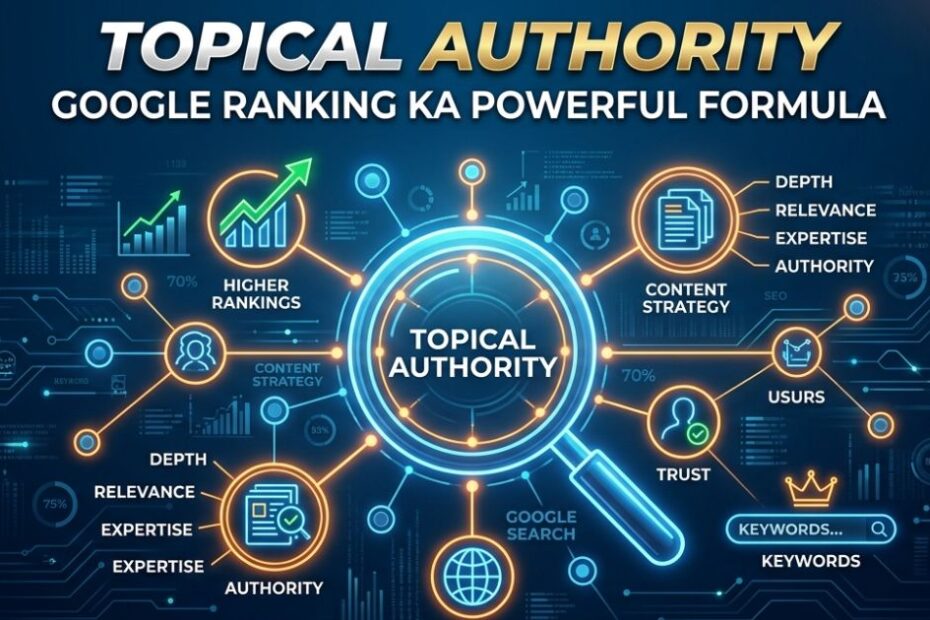
Topical Authority is one of the most powerful SEO strategies to rank higher on Google. It focuses on covering a complete topic instead of targeting just one keyword. When your website becomes a trusted source in a niche, Google automatically boosts your rankings. This approach not only increases traffic but also builds long-term credibility.
What Is Topical Authority?
To put it simply, topical authority means you are the absolute master of a specific subject. When you talk, people and computer systems listen.
Years ago, search engine algorithms (like the famous Hummingbird update) changed the rules. They stopped looking at just single words and started looking at the big picture. They want to see E-E-A-T, which stands for Experience, Expertise, Authoritativeness, and Trustworthiness. If your site talks about health or money, they care even more. They call this YMYL, or Your Money or Your Life. They want to make sure your advice is super safe and helpful.
Topic Mastery vs. Simple Relevance: What is the Difference?
You might wonder what makes a master different from someone who is just relevant. Writing one single, awesome article about dog training makes you relevant for that one day. But writing 50 amazing articles about puppy training, dog food, and dog toys? That shows you are a true master.
Consistent coverage builds deep trust. It proves you know the whole topic inside and out, not just a tiny piece of it. That is why writing just one relevant post is never enough if you want to win the big game.
Why Does Deep Expertise Matter for SEO?
So, why should you care about this? Why put in all this hard work? Here are 3 big reasons:
- Higher Search Engine Rankings: When search engines trust you, they push your pages to the very top of the search engine results. This means more eyeballs on your work!
- Building Trust: When a reader sees you have answers for every question they can think of, they feel safe. They will keep coming back to you.
- Natural Link Building: Other websites love linking to the best sources. When you are the expert, getting natural backlinks becomes so much easier. You save money and time because people naturally want to share your amazing work.
How Do Search Engines Actually Measure Your Expertise?
You might be thinking, “How do they even know how smart I am?” It is a great question! Computers use special clues to figure out if you really know your stuff.
- Content Depth: They look at how deep you go. Do you just scratch the surface, or do you dive deep?
- Internal Linking: They check how your pages connect to each other. Do your pages link together like a neat, organized web?
- User Engagement: They watch what readers do. Do people stay on your page for a long time, or do they bounce away in two seconds? If readers stay, it sends a happy signal that your page is great.
How to Build a Content Map for Your Niche
Before you start typing away, you need a plan. You need to map out your semantic SEO strategy. Think of this map as a blueprint for a giant house.
First, you pick your core idea. Let’s say it is “baking.” Then, you find topic groups in your niche. You might have one group for “baking cookies,” another for “baking bread,” and another for “cake decorating.” By building a map of all these ideas, you tell the computer exactly what your house looks like. This helps them understand your entity-based SEO, meaning they see you as a real-world concept (a baker!), not just a list of random words.
Actionable Strategies to Build Your Niche Trust
Ready to roll up your sleeves? Here are 4 powerful, authority-building content strategies you can use right now.
Focus on a Specific Niche
Do not try to be everything to everyone. It is exhausting! Instead, pick one tiny area and own it. If you love video games, do not write about every game ever made. Write only about “racing games for beginners.” Dominating a narrow subject first makes it super easy to grow later.
Build Pillar Pages and Content Clusters
Imagine a big wheel. The center is your main article, called a pillar page. The spokes of the wheel are your smaller articles, called subpages. Together, they make topic clusters. Make sure to connect them all with good links! Oh, and do not forget to create a sitemap so search engines can read your wheel easily.
Optimize for Real Concepts
Move beyond basic keyword research. Use semantic keywords, which are words that mean similar things. This shows the computer you understand the whole picture, not just one word.
Match User Intent in SEO
Always answer the exact questions your readers are asking. Are they trying to buy something, or just learn? Giving them exactly what they want makes them happy and boosts your domain authority.
Can a Brand New Blog Achieve Topical Authority?
Yes, you absolutely can! It might feel scary when you are just starting out, but every giant website started as a tiny baby blog.
The trick for new blogs is to go super narrow. Find a very small topic that the big guys forgot about. By checking your personal keyword difficulty, you can find questions that are easy for you to answer. It takes a little patience usually a few months but if you stick with it, you will see your numbers climb!
Top Tools to Track and Measure Topical Authority
You cannot fix what you do not measure. To see how well you are doing, you need some cool tools.
Do not just look at basic traffic. Use a special checker to see where you have gaps in your content. Look at your organic traffic to see if more people are finding you without paid ads. Studying a good case study from another successful site can also give you brilliant ideas on how to measure your own growth.
Conclusion
Building Topical Authority is not a quick trick but a long-term SEO investment. By consistently creating high-quality, relevant content around a specific niche, you signal expertise to Google. This improves your chances of ranking for multiple keywords instead of just one. Internal linking and content depth play a crucial role in strengthening your authority. Over time, your website becomes a go-to resource for users and search engines alike. If done correctly, Topical Authority can drive consistent, organic traffic and sustainable growth.
FAQs
What is Topical Authority in SEO?
Topical Authority refers to how well your website covers a specific subject or niche. Instead of writing random articles, you focus on creating multiple pieces of content around one main topic. This helps search engines understand that your website is an expert source. As a result, your rankings improve across many related keywords. It’s a core concept in modern SEO strategies.
How does Topical Authority improve Google rankings?
Topical Authority improves rankings by showing Google that your content is comprehensive and valuable. When you cover a topic deeply with multiple related articles, Google sees your site as more trustworthy. This increases your chances of ranking higher for both primary and long-tail keywords. It also reduces dependency on backlinks alone.
How long does it take to build Topical Authority?
Building Topical Authority usually takes time and consistency. Depending on your niche and competition, it can take a few months to see noticeable results. Regular content publishing, proper internal linking, and quality writing speed up the process. It’s not instant, but the results are long-lasting.
What type of content helps build Topical Authority?
In-depth blog posts, guides, tutorials, and cluster content work best for building authority. You should cover subtopics, FAQs, and related queries within your niche. The goal is to answer every possible question a user might have. This creates a strong content ecosystem around your main topic.
Is Topical Authority better than backlinks?
In-depth blog posts, guides, tutorials, and cluster content work best for building authority. You should cover subtopics, FAQs, and related queries within your niche. The goal is to answer every possible question a user might have. This creates a strong content ecosystem around your main topic.