
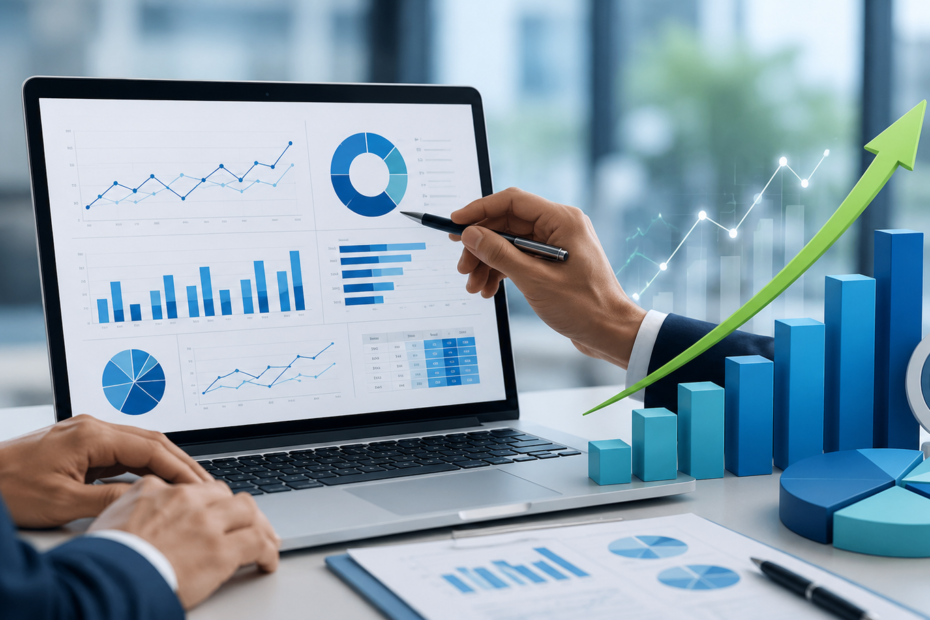
Performance analytics helps businesses track, measure, and improve their overall results using real-time data and insights. It allows companies to monitor KPIs, marketing campaigns, employee productivity, and customer behavior to make smarter decisions and boost growth.
What exactly is this data strategy?
Think of it as your business’s health monitor. It takes all the scattered information from your sales, marketing, and operations, and puts it into a clear, visual dashboard. You stop guessing and start knowing.
Instead of staring at endless spreadsheets, you get clear answers. You see exactly where your team is winning and where things are falling apart. It tracks your key performance indicators (KPIs) in real-time, allowing you to course-correct before small hiccups become massive disasters.
This is not about looking at past mistakes. It is about predictive analytics. It is about seeing the future, anticipating trends, and moving faster than your competition.
Why measuring your metrics matters
Data without action is just trivia. When you measure the right metrics, you unlock operational efficiency that completely transforms your bottom line. You stop wasting time on projects that do not deliver.
Customer satisfaction skyrockets. Why? Because you actually know what your customers want, when they want it, and how they behave. You can tailor your entire approach to serve them better.
Let’s look at real-world scenarios where this data-driven approach is changing the game:
- Healthcare: Hospitals use real-time analytics to track patient readmissions and staff shortages. They predict emergency room surges before they happen, saving lives and reducing wait times.
- Sports: Elite sports teams track athlete fatigue, speed, and recovery times. Coaches adjust training loads instantly to prevent injuries, keeping their star players on the field and winning championships.
- Retail: Stores track inventory and customer foot traffic. They know exactly when to stock up on winter coats and when to discount summer gear, maximizing their profit margins.
How does performance analytics work?
Building a data powerhouse does not happen by accident. It takes a deliberate, structured approach. Here is exactly how it works, step by step.
Step 1: Data Collection
Everything starts with gathering the raw materials. You pull data from your customer relationship management (CRM) software, your website, and your supply chain tools.
You need a central hub. This means connecting all your scattered systems so they talk to each other. Clean data is the foundation of brilliant insights.
Step 2: Data Analysis
Now, the magic happens. You apply machine learning and business intelligence (BI) tools to make sense of the noise.
The software looks for hidden patterns. It flags anomalies. It uses predictive models to show you what will likely happen next month based on what happened today.
Step 3: Visualization and Decision-Making
Nobody wants to read raw code. You need data visualization tools that turn complex numbers into beautiful, easy-to-read charts.
When your leadership team looks at a real-time dashboard, they see red, yellow, and green indicators. Red means act now. Green means push harder. Decisions that used to take weeks now take seconds.
Key features of a robust platform
Not all tools are created equal. If you are shopping for a solution, you need specific features to win. Look for these non-negotiables:
- Real-time alerts: You need a system that pings your phone the second a critical metric drops below your target.
- Customizable dashboards: Your CEO needs a different view than your marketing manager. Your platform must adapt to the user.
- Seamless integration: It must play nice with your existing tech stack. If it cannot connect to your CRM, walk away.
- Automation and self-service: Your team should not need a PhD in data science to pull a report. It needs to be incredibly intuitive.
Common data challenges (and how to crush them)
Let’s be real. Implementing a massive data strategy is not always a walk in the park. You will hit roadblocks. Here is how to smash through them.
Challenge 1: Garbage in, garbage out.
If your data is messy, your insights will be wrong.
The Fix: Invest heavily in data cleaning before you launch. Set strict rules for how your team enters information into your systems.
Challenge 2: Analysis paralysis.
You have too many metrics, and everyone is overwhelmed.
The Fix: Focus on three to five core metrics that actually move the needle. Ignore the vanity metrics that look good but mean nothing.
Challenge 3: Siloed information.
Marketing refuses to share data with sales.
The Fix: Break down the walls. Use a unified cloud-based analytics platform that everyone in the company accesses. Transparency wins.
Expert insights Maximizing your ROI
I have seen companies spend millions on software, only to use it as an overpriced calculator. Do not make that mistake.
To get a massive return on investment, you must align your data with your business goals. If your goal is to reduce customer churn, every dashboard should revolve around customer health scores.
Second, train your people. A brilliant tool is useless if your team is afraid of it. Invest in continuous learning. When your frontline workers understand how to read the data, they make brilliant micro-decisions every single day.
Finally, leverage AI and machine learning. Let the robots do the heavy lifting. When AI handles the repetitive sorting, your human team can focus on creative strategy and relationship building.
Conclusion
Using performance analytics can improve efficiency, increase ROI, and help businesses achieve their goals faster. With accurate data tracking and reporting, companies can identify weaknesses, optimize strategies, and stay ahead of competitors.
FAQs
What is the difference between tracking KPIs and predictive analytics?
Tracking KPIs tells you what happened in the past. Predictive analytics uses that historical data to accurately forecast what will happen in the future.
How do I choose the right metrics to measure?
Start with your biggest business goal. If you want revenue growth, track lead conversion rates and average deal size. Only measure what you can actively influence.
Can small businesses benefit from these tools?
Absolutely. Cloud-based platforms are cheaper than ever. A small business tracking its customer acquisition cost will scale much faster than one flying blind.
How do I ensure data security?
Choose platforms with enterprise-grade encryption. Limit access based on employee roles, and enforce strict multi-factor authentication across your entire organization.
How is voice search changing data tools?
Voice search optimization allows managers to literally ask their phone, “What were yesterday’s sales?” Conversational queries are making real-time decision-making faster and more accessible.