
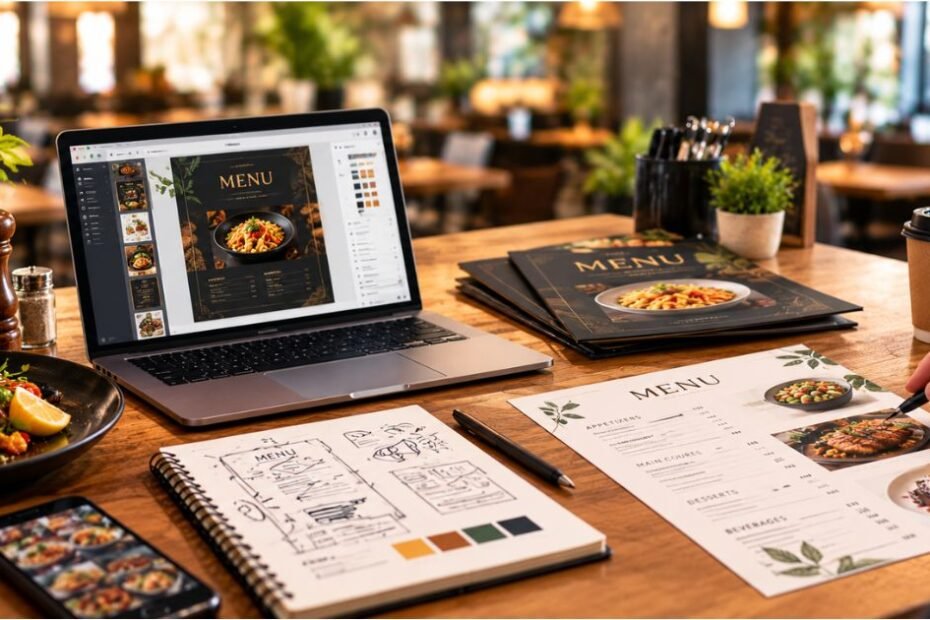
A restaurant menu design service creates a custom menu layout (print, digital or both) that matches your brand and guides guests toward your most profitable items. Costs range from about 10–25 a month for DIY tools to a few hundred dollars for a freelancer and more for a full agency project. The right choice depends on your budget, how often your menu changes, and whether you need strategy or just a nice-looking file.
What Does a Restaurant Menu Design Service Actually Include?
A restaurant menu design service is a paid service that turns your dishes, prices and brand into a finished, print-ready or screen-ready menu. That’s the short version. In practice, “menu design” can mean very different things depending on who you hire.
Here’s how the scope usually breaks down:
| Service component | What it means | Often included? |
| Layout and typography | How items are arranged, fonts, spacing, sections | Yes, in almost every package |
| Branding integration | Your logo, colors and style carried into the menu | Usually |
| Menu copywriting | Item names and descriptions written to sell | Sometimes, or as an add-on |
| Photography or illustration | Food photos, icons or artwork | Often extra |
| Menu engineering | Placement and pricing choices based on profit | Rare, mostly agencies and specialists |
| Print-ready files | PDF, usually CMYK at 300 dpi | Yes |
| Digital versions | Screen-sized files, TV boards, QR-ready pages | Varies |
| Source files | Editable files (AI, PSD, INDD, editable Canva) | Ask. This is the big one. |
| Revisions | Rounds of changes after the first draft | Limited or unlimited, so check |
Here’s the catch. Many low-cost gigs deliver only a finished PDF. It looks great until your price changes next month and nobody can edit it.
Before you hire, write down which of these nine items you actually need. That list becomes your brief, and it’s the fastest way to compare quotes fairly.
Types of Menu Design Services (and Who Each Fits)
You have five main paths. None is “best.” Each fits a different kind of restaurant.
Freelancers and marketplaces
Sites like Fiverr, Upwork and Dribbble connect you with independent designers. On Fiverr’s menu design category, the visible listings I checked start at roughly $10 to $70, though what you get at each price varies a lot.
Best for: one-time custom print menus when you already handle your own printing.
Watch out for: uneven quality. Review portfolios closely, and confirm you’ll receive source files.
Design agencies
Agencies bundle design, branding and sometimes menu strategy. Many US companies market “custom menu design” this way, from small studios to hospitality branding firms.
Best for: new restaurant launches, rebrands, multi-location groups.
Watch out for: higher price and longer timelines. One agency blog says most custom projects finish “within a few weeks.”
Book Our: Resturant Marketing Services
DIY tools and template platforms
Canva and iMenuPro let you build menus yourself. iMenuPro focuses on restaurants, offering drag-and-drop layouts and QR menus. One third-party guide lists it at around 10–25 a month. Confirm current pricing on their sites, since plans change.
Best for: food trucks, pop-ups and owners who update menus often.
Watch out for: the result depends on your design skills. Templates can look generic.
Print-on-demand services
Vistaprint sells printed menus in flat, bi-fold and tri-fold formats, with templates or your own uploaded design. They’re print shops, not design studios, so you supply the design or use a template.
Best for: getting professionally printed copies fast.
Watch out for: you still need the actual design.
Managed digital menu services
Some providers build and maintain your website menu for you, often tied to online ordering. One provider I reviewed advertises a flat monthly plan of 159–199 with a 48–72 hour turnaround after you submit your content. If you’d rather have a custom-built ordering system instead of a templated one, our overview of what a custom web app development company in the USA actually delivers is a useful comparison point.
Best for: owners who want a live, always-updated digital menu, not a print file.
Watch out for: you get a hosted digital menu, not a design file to send to a print shop.
How Much Does Restaurant Menu Design Cost?
Restaurant menu design costs range from roughly 0–25 per month for DIY tools to several hundred dollars for a custom freelance menu, with agency projects costing more. The table below compares each path.
| Provider type | Typical cost | Typical turnaround | Source files? |
| DIY tool (Canva, iMenuPro) | About 0–25/month | Same day, depending on your effort | You control them |
| Marketplace freelancer | Visible Fiverr listings from ~10to~70+; one guide cites 50–300 for custom work | 12 hours to ~5 days | Varies. Ask before ordering |
| Design contest (DesignCrowd) | One guide cites 99–300+ | About 5–7 days | Usually after choosing a winner |
| Agency or specialist studio | Est. several hundred to $1,500+ for a multi-page custom menu (verify with quotes) | Typically a few weeks | Usually |
| Managed digital menu | One provider advertises 159–199/month | About 48–72 hours after content is submitted | Digital hosting, not a print file |
Honesty note: Prices come from provider pages and third-party guides, so they’re snapshots, not guarantees. The agency range is my informed estimate. Get 2–3 written quotes before you decide.
Costs people forget:
- Printing. Design and printing are separate. Vistaprint, for example, prices printed menus on top of any design.
- Photography. Food photos are often extra.
- Revisions. Some sellers cap them.
- Updates later. A price change should not cost you a new project.
How Do I Choose the Right Menu Design Provider?

Choose a provider by checking restaurant-specific portfolios, confirming what files you’ll own, and asking how they handle revisions and menu strategy. A clean checklist beats a gut feeling.
Portfolio red flags
- Lots of posters and flyers, no real menus
- Every design looks the same regardless of the client’s brand
- Text that’s hard to read at menu size
- Menus that look good but bury prices or bury the dishes that make money
Questions to ask before you hire
- Do you have restaurant menu samples similar to mine (cafe, bar, fine dining)?
- Which files will I receive, and are editable source files included?
- How many revisions are included?
- Do you help with item descriptions or layout for profit, or just visuals?
- What’s the timeline from brief to print-ready file?
- Can you deliver both print and digital sizes?
- Who owns the fonts, images and artwork used?
- What does it cost if I change prices or items next month?
If a provider dodges question 2 or 7, keep looking.
Who Owns Your Menu Files?
Usually you own the finished design, but you may not receive the files needed to edit it. These are two different things, and mixing them up is the most expensive mistake in menu design.
Here’s the difference:
- Final files: a flattened PDF or JPG. Print-ready, but hard to edit.
- Source files: the editable originals (for example AI, PSD, INDD or an editable Canva link). These let anyone update text and prices later.
Fiverr’s own FAQ says whether you can change a menu after delivery depends on the file types agreed in the order. It notes print menus can include source or vector files, while TV menus need more complex software.
Also confirm:
- Fonts. Some fonts need a separate license for commercial use.
- Images. Stock photos may have licensing limits.
- Print specs. Vistaprint’s upload guidelines call for 300 dpi and set sizes per format. Flat menus, for example, come in 3.75×8.25″, 8.5×11″ and 11×17″.
Put file ownership in writing before you pay. A short email saying “I’ll receive editable source files and font/image license details” is enough for small projects.
Does Menu Design Really Affect Sales?
Yes, menu design can influence what guests order, but the evidence is strongest for specific practices, not for “pretty” design alone. Be wary of any provider promising a fixed sales lift with no source.
The best-known framework is menu engineering, introduced by Michael Kasavana and Donald Smith in the early 1980s. It sorts every dish by two things: how popular it is and how profitable it is.
| Category | Popularity | Profit | What to do |
| Star | High | High | Protect and feature it |
| Plowhorse | High | Low | Adjust the price or recipe cost slightly |
| Puzzle | Low | High | Promote it: better placement, a better description |
| Dog | Low | Low | Consider removing it |
Menu design supports this work. It decides which dishes get visual attention (a box, a callout, a photo) and which get a plain line of text.
What to be careful about. You’ll see advice about “golden triangles” and “sweet spots” on a menu page. Research on where eyes land is mixed, so treat those as things to test, not rules. Track your own sales mix before and after a redesign.
Illustrative example (hypothetical numbers)
Imagine a burger priced at $14 with a food cost of $4.20. Its contribution margin is $9.80. A pasta dish is priced at $16 with a food cost of $7.20, so its margin is $8.80.
The pasta looks pricier, but the burger earns you more per plate. If guests order the pasta twice as often, a good layout could nudge some of them toward the higher-margin burger. These figures are made up to show the math. Use your own costs.
Print, Digital or QR: Which Menu Format Wins?
Choose print for atmosphere, digital for fast updates, and QR for low-cost flexibility, and consider combining them. Most restaurants end up with a hybrid.
| Format | Strengths | Weaknesses | Best for |
| Print (flat, bi-fold, tri-fold) | Feels premium, no phone needed, strong branding | Costs reprinting when prices change | Sit-down and fine dining |
| Digital menu board / TV | Easy to rotate specials, eye-catching | Needs screens and a display setup | Quick-service, cafes |
| QR code menu | Instant updates, low cost | Needs a phone and signal; some guests dislike it | Bars, events, high-turnover spots |
| Website / online ordering menu | Serves takeout and delivery, always live | Needs upkeep and hosting | Restaurants taking online orders |
Pro move: Design once, then export multiple versions (print, screen, QR page) from the same source files. This is exactly why file ownership matters. If your online menu is part of a larger site, keep an eye on load speed too a slow-loading menu page loses hungry customers fast, which is exactly what our Website Speed Optimization Services guide covers fixing.
Match the fold to your service style. Vistaprint suggests flat menus for sit-down restaurants, bi-folds for fast-casual, and tri-folds for takeout and delivery.
Menu Compliance Basics in the U.S.
Some menus must show nutrition or allergen information by law, so check the rules before you design. This isn’t legal advice, so confirm with your local health department.
- Calorie labeling. The FDA’s menu labeling rule requires calorie information on menus and menu boards for chain restaurants and similar retail food establishments with 20 or more locations doing business under the same name. Independent single-location restaurants generally aren’t covered. If you operate several locations, keeping your menu, hours, and compliance info consistent across every listing is its own project our guide to Local SEO for Multiple Locations covers how to manage that without your online menus drifting out of sync.
- Allergens. The nine major food allergens under federal law are milk, eggs, fish, crustacean shellfish, tree nuts, peanuts, wheat, soybeans and sesame (added in 2023). Federal rules focus on packaged food, but some states and cities add their own menu or allergy-notice rules for restaurants. Check yours.
- Accessibility. Digital menus should be readable by screen readers. A scanned image or flattened PDF often isn’t. If you use QR menus, ask whether the page is accessible. iMenuPro states its QR menus are ADA-compliant, but confirm this for any provider.
Ask your designer to leave space for allergen icons and calorie counts from day one. Squeezing them in later usually ruins a layout.
How Long Does Menu Design Take?
Simple menus can be done in a day or two, while custom multi-page projects often take a few weeks. Turnaround depends mostly on how fast you send clear content.
- Brief and content (1–3 days). Send your item list, prices, logo and a few menus you like.
- First draft (1–7 days). Marketplace sellers can be fast. Agencies take longer.
- Revisions (2–7 days). Each round adds time, so batch your feedback.
- Final files (1 day). Print-ready and screen-ready exports.
- Printing (varies). This is separate. Order a small test run first.
Fast-track tip: Late content is the number-one cause of delays. Have prices and item names final before you start.
The Menu Brief Scorecard
Use this to compare providers side by side. Score each from 0 (no) to 2 (yes, clearly), then total out of 16.
| # | Criterion | 0 | 1 | 2 |
| 1 | Restaurant-specific portfolio | None | Some | Strong |
| 2 | Editable source files included | No | Extra fee | Yes |
| 3 | Clear revision policy | Unclear | Limited | Defined and fair |
| 4 | Menu strategy input (layout for profit) | None | Basic | Explained clearly |
| 5 | Print and digital versions | One only | Extra fee | Both included |
| 6 | Font and image licensing explained | No | Partly | Fully |
| 7 | Realistic timeline in writing | No | Vague | Specific |
| 8 | Cost to update later is stated | No | Vague | Clear |
How to read it:
- 13–16: Strong fit. Move forward.
- 9–12: Good, but close the gaps in writing.
- 0–8: High risk. Keep shopping.
[Needs your input: if you or your client run real menu projects, add your own before/after sales-mix data here. It’s the strongest original proof you can publish.]
Conclusion
Restaurant menu design is an important investment because your menu affects how customers understand your offerings and make purchasing decisions. Costs can vary based on design complexity, customization, number of menu items, format, and the level of professional support required. Before choosing a restaurant menu design service, compare portfolios, pricing, revisions, turnaround time, and whether the service can create designs that match your restaurant’s brand and customer experience.
FAQs
How much does a restaurant menu design service cost?
Costs run from about 0–25 a month for DIY tools to a few hundred dollars for a freelancer, and more for agencies. Print and photography are usually extra. Get several written quotes to compare.
What should a restaurant menu include?
Item names, clear prices, short descriptions, section headings, your logo and contact details. Add allergen notes, and calorie counts if the law requires them for your business.
Is it worth hiring a professional menu designer?
Often yes, if you want a distinctive brand or help highlighting profitable dishes. If your menu changes weekly and your budget is tight, a good DIY tool may be enough.
Do I get the source files from a menu designer?
Not always. Many sellers deliver only a final PDF. Ask for editable source files and license details in writing before you order.
How long does menu design take?
Simple menus can take one to a few days. Custom multi-page projects with revisions often take a few weeks, plus printing time.
What’s the difference between menu design and menu engineering?
Menu design is how the menu looks and reads. Menu engineering uses sales and cost data to decide which dishes to promote, reprice or remove. The best projects combine both.
Should I use a QR menu or a printed menu?
It depends on your guests and service style. Print feels premium, and QR updates instantly. Many restaurants use both.
What file format do I need for printing a menu?
Most print shops want a high-resolution PDF, usually 300 dpi. Vistaprint’s guidelines list PDF and several other formats at 300 dpi. Check your printer’s exact specs first.
