
Website speed optimization services help improve your site’s loading time, user experience, and search engine rankings. A faster website keeps visitors engaged, reduces bounce rates, and increases conversions. Whether you run a business website, blog, or eCommerce store, optimizing speed is essential for online success.
Why a Slow Website Is Quietly Destroying Your Business
Most business owners don’t realize their site is slow until they check. And by then, the damage is already done.
Here’s the reality: a 0.1-second improvement in page load time increases conversion rates by up to 8%, according to a Deloitte study. Flip that around every extra second of load time chips away at your bottom line.
Google’s Core Web Vitals update made speed an official ranking factor. If your pages fail those thresholds, Google pushes you down the results page, even if your content is excellent. A strong SEO strategy means nothing if a slow website stops Google from ranking your pages in the first place.
What Google’s Core Web Vitals Actually Measure
Core Web Vitals are three specific signals Google uses to measure real-world user experience:
- LCP (Largest Contentful Paint): How fast your main content loads. Google wants this under 2.5 seconds.
- INP (Interaction to Next Paint): How quickly your site responds when someone clicks or taps. Under 200 milliseconds is the target.
- CLS (Cumulative Layout Shift): How stable your page looks while loading. A score under 0.1 means things aren’t jumping around unexpectedly.
Failing even one of these signals can drag down your rankings. Failing all three? That’s a serious problem.
The Real Business Cost of Poor Performance
Let’s make this concrete:
- Sites that load in 1 second convert 3x better than sites that load in 5 seconds (Portent, 2022)
- A 1-second delay in mobile load time reduces conversions by up to 20%
- Google reports that 53% of mobile users abandon a site that takes more than 3 seconds to load
Slow isn’t just inconvenient. It’s expensive. And it directly undermines everything your PPC campaigns and SEO efforts are working to achieve.
What Professional Website Speed Optimization Services Include
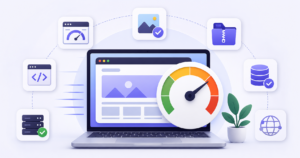
When you work with a professional team, you’re not just flipping a setting and hoping for the best. You’re getting a tailored, site-specific plan built around your actual performance issues.
Here’s what comprehensive website speed optimization services typically cover:
- Full-site speed audit Baseline measurement using PageSpeed Insights, GTmetrix, and Lighthouse
- Core Web Vitals diagnosis Identifying exactly which LCP, INP, or CLS issues are failing, and on which pages
- Server response time (TTFB) optimization Faster server responses mean faster everything else
- Image compression and next-gen formats Converting images to WebP or AVIF, applying lazy loading
- CSS, JavaScript, and HTML minification Removing unnecessary code weight without breaking your site
- Browser and server-side caching So repeat visitors load your site almost instantly
- Content Delivery Network (CDN) setup Serving your content from servers closest to your users
- Third-party script auditing Identifying slow external scripts (chat widgets, tracking pixels, fonts) and managing their load order
- Mobile speed optimization Because mobile users now account for more than 60% of web traffic
- Ongoing monitoring and reporting So performance doesn’t drift back over time
How Our Speed Optimization Process Works, Step by Step
This is where most service pages go silent. They list features but never show you how the work actually gets done. Here’s the full process:
Step 1: Free Speed Audit
We run your site through PageSpeed Insights, GTmetrix, and Lighthouse. This gives us a baseline score across mobile and desktop, flags Core Web Vitals failures, and shows us the specific issues dragging your load time down.
Step 2: Core Web Vitals Diagnosis
We map every failing metric to its root cause. Is your LCP slow because of a large hero image? Is INP being impacted by a third-party chat script? Is CLS triggered by a font loading late? This is where the real detective work happens.
Step 3: Prioritization Roadmap
Not every fix has the same impact. We rank issues by performance gain versus implementation effort, so the most valuable improvements happen first.
Step 4: Technical Implementation
Our team implements the fixes directly on your site code-level changes, server configuration, CDN setup, image pipeline optimization. No guesswork. No trial and error.
Step 5: Validation Testing
Before we hand anything back, we re-test across desktop and mobile and verify that Core Web Vitals have improved. We also check that nothing in your site’s functionality or design has been affected.
Step 6: Monitoring and Reporting
Speed degrades over time. New plugins, content changes, and CMS updates can re-introduce issues. Monthly monitoring catches these early, before they hit your rankings.
Professional Service vs. DIY Speed Plugin What’s the Right Call?
This is the question most buyers are quietly asking. Plugins like NitroPack, WP Rocket, and W3 Total Cache can deliver real improvements but they’re not always the right tool for every job.
| Factor | Professional Service | DIY Speed Plugin |
| Setup complexity | Handled entirely by experts | Requires technical confidence |
| Customization | Fully tailored to your site | Template-based optimization |
| Core Web Vitals accuracy | Deep root-cause remediation | Partial fixes for common issues |
| Ongoing monitoring | Included | Manual — easy to forget |
| Risk of site breakage | Managed, tested, and controlled | Higher without development skills |
| Best suited for | Businesses, agencies, eCommerce | Small blogs, simple sites |
The honest answer: If your site generates real revenue, or if organic traffic is a meaningful part of your business, a professional service pays for itself fast. If you run a personal blog with low traffic stakes, a good plugin might be all you need.
The risk with plugins isn’t that they don’t work it’s that they apply generic fixes to site-specific problems. A broken checkout page caused by aggressive JavaScript deferral doesn’t show up in your PageSpeed score. It shows up in your sales data.
What Does Website Speed Optimization Cost in 2026?

No two websites are identical, which means the scope of website speed optimization can vary significantly from one business to another. Several factors influence the amount of work required and the overall complexity of the project.
Site Size
A small brochure-style website and a large eCommerce store with thousands of products require very different optimization strategies. More pages, assets, and functionality typically mean a broader scope of work.
CMS Platform
The platform your website uses plays a major role in optimization opportunities. WordPress, Shopify, Drupal, Magento, and custom-built websites each have unique performance considerations and technical requirements.
Current Performance Baseline
The amount of optimization needed depends on your site’s existing performance. A website with significant speed issues will generally require more extensive improvements than one that is already relatively well optimized.
CDN Setup Requirements
Businesses serving customers across multiple regions often benefit from a Content Delivery Network (CDN). Implementing and configuring a CDN can improve loading times for global audiences but may add additional technical considerations.
One-Time Optimization vs. Ongoing Maintenance
Some businesses only need a one-time performance improvement project, while others benefit from ongoing monitoring, testing, and maintenance to ensure their website remains fast as new content, features, and updates are added.
Why Website Speed Matters
Website speed directly affects user experience, search engine visibility, and conversion rates. Slow-loading pages can increase bounce rates, reduce engagement, and negatively impact revenue opportunities. Faster websites create a smoother user experience and help visitors reach their goals more efficiently.
Focus on Value, Not Just Cost
The most important question isn’t simply how much website speed optimization costs. The better question is how much a faster website can contribute to your business goals. Improvements in user experience, search visibility, lead generation, and online sales often provide benefits that extend well beyond the initial optimization effort.
A well-optimized website isn’t just faster it creates a stronger foundation for long-term digital growth.
How Long Does Website Speed Optimization Take?
| Phase | Typical Timeframe |
| Initial audit and diagnosis | 2–5 business days |
| Implementation (standard site) | 1–2 weeks |
| Implementation (large/complex site) | 3–6 weeks |
| Validation and QA testing | 3–5 business days |
| Measurable score improvements | Immediate post-implementation |
| Ranking and traffic improvements | 4–12 weeks post-implementation |
Speed score improvements show up fast usually within days of implementation. SEO ranking improvements take longer because Google needs to re-crawl and re-evaluate your pages. Four to twelve weeks is a realistic window for organic visibility gains.
Who Actually Needs Professional Website Speed Optimization Services?

Speed issues hurt some businesses more than others. Here’s who benefits most:
- eCommerce stores Every second of delay directly reduces add-to-cart and checkout rates
- Local service businesses Poor mobile speed hurts your Google Maps and local pack rankings
- SaaS companies Conversion-critical landing pages can’t afford high bounce rates
- Content publishers Ad revenue depends on pages loading fast enough for impressions to count
- Marketing agencies Managing speed performance for multiple client sites requires systematic expertise
- Any business where organic traffic drives revenue If Google sends you customers, Core Web Vitals scores directly affect your pipeline
What We’ve Learned Optimizing 500+ Websites
Here’s what years of hands-on work actually teach you the patterns you only see when you’ve done this enough times.
The biggest LCP killer is rarely what you think. Most people assume large images are the main culprit. And yes, uncompressed images slow sites down. But in our experience, render-blocking JavaScript often from analytics scripts, chat widgets, or third-party ad tools is a more common offender. It delays everything else from loading, even when the images are perfectly optimized.
Mobile speed is still dramatically worse than desktop, even in 2026. Despite years of mobile-first indexing, most sites we audit load 2.5 to 3 times slower on mobile than desktop. This matters because Google primarily evaluates your mobile experience when deciding where to rank you.
Small gains compound quickly. A 0.5-second improvement in load time sounds minor. In practice, it consistently produces measurable improvements in bounce rate and conversion rate within 60 days. We’ve seen eCommerce sites recover 15–25% of abandoned sessions just by clearing their Core Web Vitals failures.
One-time fixes don’t stay fixed. This is the part most businesses don’t anticipate. A WordPress plugin update, a new marketing pixel, or a theme change can quietly re-introduce the same performance issues weeks after optimization. Ongoing monitoring isn’t optional it’s what protects your investment.
Optimize Our: Website Speed
Platforms We Optimize
Our website speed optimization services work across all major CMS and eCommerce platforms:
- WordPress and WooCommerce
- Shopify
- Webflow
- Drupal
- Magento / Adobe Commerce
- Custom-built sites and headless architectures
Does Website Speed Affect My Google Ranking?
Yes directly and measurably.
Google officially added Core Web Vitals as a ranking signal in 2021. Pages that deliver a fast, stable, responsive experience are rewarded with better placement. Pages that fail these benchmarks get pushed down, even when their content is strong.
Beyond ranking, speed affects your crawl budget. If Googlebot finds your pages slow to respond, it crawls fewer of them per visit which means new content gets indexed more slowly.
Fix your speed, and the ranking benefits tend to follow within a few weeks.
How Do I Know If My Website Needs Speed Optimization?

Run a quick self-diagnosis using this checklist:
- PageSpeed Insights score below 70 on mobile or desktop pagespeed.web.dev is free
- LCP above 2.5 seconds visible in PageSpeed Insights and Google Search Console
- Core Web Vitals flagged as “Poor” or “Needs Improvement” in Search Console’s Experience report
- Bounce rate above 55% on key landing pages
- Mobile load time significantly slower than desktop
- Recent organic ranking drops with no changes to content or backlinks
If two or more of these apply to your site, speed is almost certainly a factor in your underperformance.
Is Website Speed Optimization a One-Time Fix or an Ongoing Service?
Both, depending on your needs and they serve different purposes.
A one-time optimization project fixes your current performance issues, clears Core Web Vitals failures, and gets your PageSpeed scores into a healthy range. That’s a meaningful, measurable win.
An ongoing retainer keeps those gains intact as your site evolves. Content updates, new plugins, third-party integrations, and platform upgrades all introduce potential regressions. Monthly monitoring catches these before they show up in your rankings.
Think of it like this: one-time optimization is the surgery. Ongoing monitoring is the rehab that makes sure it sticks.
Conclusion
Investing in website speed optimization services can significantly improve your website’s performance, user satisfaction, and SEO results. With faster load times and a smoother browsing experience, your site can attract more visitors, generate more leads, and support long-term business growth.
FAQs
What is website speed optimization?
Website speed optimization is the process of improving how fast your website loads for real users. It involves technical changes to your code, server, images, and content delivery that reduce load times, improve Core Web Vitals scores, and boost both SEO rankings and conversion rates.
How much do website speed optimization services cost?
Pricing depends on your site’s size, platform, and current performance level. Most US businesses invest between $500 and $5,000 for a one-time optimization project, with ongoing retainers ranging from $300 to $1,000+ per month for continuous monitoring and maintenance.
How long before I see results?
PageSpeed scores typically improve within days of implementation. Organic ranking and traffic improvements generally follow within 4 to 12 weeks, as Google re-crawls and re-evaluates your pages based on the new performance signals.
Will speed optimization break my website’s design or features?
Not when done properly. All changes are implemented at the code and server level, tested thoroughly before deployment, and validated against your site’s full functionality. A professional service manages this risk unlike some plugins that apply broad changes without site-specific testing.
Can I just use a speed plugin instead of hiring a professional service?
Plugins work well for simple sites with straightforward performance issues. For businesses where organic traffic and conversion rates are business-critical, a professional service provides deeper diagnosis, site-specific fixes, and accountability that plugins can’t match. The question is how much your performance actually costs you.