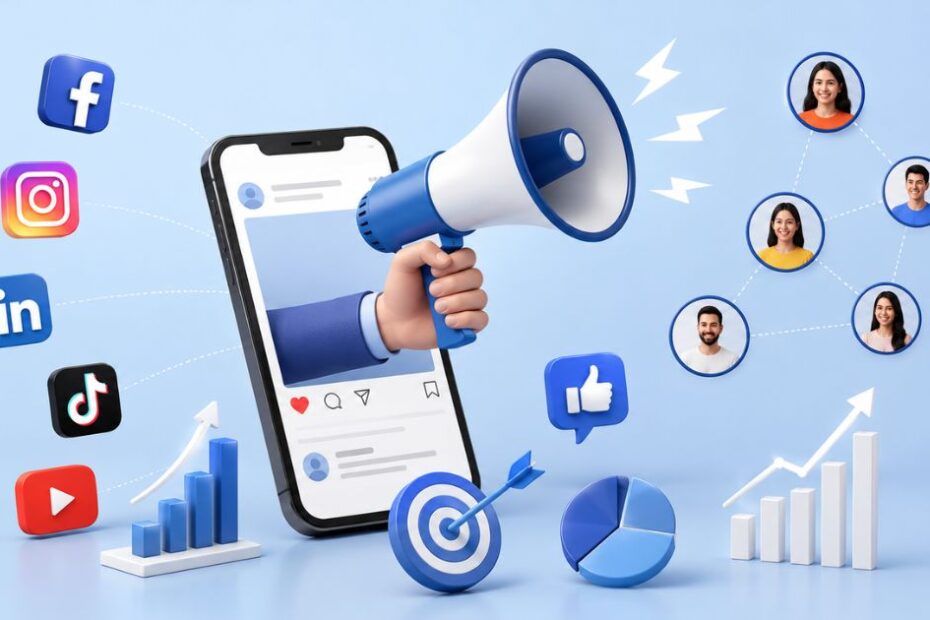
Social Media Marketing (SMM) is powerful because it allows businesses to connect directly with their target audience, build brand awareness, and drive engagement in real time. If you’re wondering why is SMM so powerful, the answer lies in its ability to reach the right people at the right time through highly targeted campaigns. Platforms like Facebook, Instagram, LinkedIn, and TikTok help brands reach millions of users while offering precise audience targeting. SMM is cost-effective, measurable, and capable of generating leads, sales, and long-term customer relationships.
What Is Social Media Marketing (SMM)?
Social media marketing (SMM) is the use of platforms like Instagram, TikTok, Facebook, and LinkedIn to promote your brand, connect with customers, and drive sales. It’s not just posting pretty pictures. It’s a strategy one built on content, conversation, and data working together.
Think of it as having a storefront, a customer service desk, and a research lab all rolled into one app.
Why Is Social Media Marketing So Powerful?
Here’s the heart of it. SMM is powerful because it does three things at once, and almost no other channel can claim all three.
- Connection it reaches audiences traditional ads simply can’t touch
- Interaction it turns customers into conversation partners, not just viewers
- Customer data it gives you insight into what people actually want
Let’s go deeper on each one, because this is where the magic really happens.
Connection Reaching Audiences at a Scale No Channel Can Match
There are now over 5.6 billion social media users worldwide, spending more than two and a half hours a day scrolling, watching, and shopping across nearly seven different platforms a month. That’s not a niche audience. That’s most of the planet.
Here’s what makes this connection different from a billboard or a TV spot: you can choose exactly who sees your message. Age, location, interests, even shopping habits you can target all of it.
Imagine a small skincare brand in Texas. With a TV ad, they’d be paying to reach people in five states who’ll never buy. With social media marketing, they can speak directly to 25-to-34-year-olds with sensitive skin who follow beauty influencers. That’s not guessing. That’s precision.
Interaction Real-Time, Two-Way Engagement
Old-school advertising talked to people. Social media marketing talks with them.
When someone comments on your post, shares it with a friend, or tags your brand in their own content, that’s electronic word-of-mouth eWOM for short. And it’s gold. People trust a friend’s recommendation far more than any ad you could buy.
Here’s the proof: customers who engage with a brand on social media spend 35 to 40% more on that brand’s products than customers who don’t. That single stat should make any business owner sit up straight.
This interaction also works as free advertising. Every share, every comment, every duet on a video is somebody else doing your marketing for you for free, and with their own credibility attached.
Customer Data Marketing Intelligence Built Into the Platform
Here’s the part most people overlook. Every like, click, and scroll-past tells you something. Social media platforms hand you a research department for free.
You don’t need to guess what your audience wants. The analytics dashboard tells you:
- Which posts people actually finish watching
- What time your audience is online
- Which products they keep clicking but not buying
- What language and tone gets the best response
That last point matters more than people realize. A health brand might discover their audience responds better to “feel stronger” than “lose weight.” That’s not a hunch that’s data talking.
How Does Social Media Marketing Work?

So how does all this actually come together? Here’s the simple version, step by step:
- Pick your platforms based on where your exact audience spends time
- Create content that entertains, teaches, or solves a problem not just sells
- Post consistently so the algorithm and your audience both learn to expect you
- Engage back reply to comments, answer DMs, join the conversation
- Track your data and adjust based on what’s actually working
- Mix organic posts with paid ads to extend your reach strategically
It’s less about luck and more about a repeatable rhythm. Brands that treat SMM like a system — not a guessing game are the ones who win long term.
SMM vs. SEO vs. Traditional Advertising Which Actually Performs Better?
This is the question every marketing budget meeting eventually asks. Here’s an honest, no-spin comparison:
| Factor | Social Media Marketing | SEO | Traditional Advertising |
| Speed to results | Fast days to weeks | Slow months | Fast, but expensive |
| Cost to start | Low | Low-to-moderate | High |
| Targeting precision | Very high | Moderate | Low |
| Two-way interaction | Yes | No | No |
| Long-term durability | Needs constant activity | Compounds over time | Stops when budget stops |
| Trust-building power | Very high (social proof) | High (authority) | Moderate |
The honest answer? They’re not really rivals they’re teammates. SEO brings people who are already searching. SMM builds the relationship and trust that gets them to actually buy. Traditional ads still work for broad awareness, but they can’t talk back, and today’s customers expect a brand that does.
The Hidden Driver Nobody Talks About: Social Platforms Are Now Beating Google for Discovery
Here’s something that should genuinely surprise you. TikTok, Instagram, and YouTube together now account for over 60% of product discovery overtaking Google itself.
Read that again. People aren’t typing into a search bar first anymore. They’re scrolling, seeing a product in a video, and buying it right there.
This changes everything about why SMM is so powerful. It’s no longer just a marketing channel sitting beside your website. For a growing number of customers, social media is the front door to your business not a side entrance.
Short-Form Video and Social Commerce Why 2026’s SMM Looks Nothing Like 2022’s
If your mental picture of social media marketing is still static photos and the occasional Facebook ad, it’s time for an update.
- Short-form video delivers the highest ROI of any content format marketers use today
- Social commerce sales hit $1.3 trillion globally in 2025 and are projected to nearly double by 2026
- 97% of Gen Z shoppers say social media is their main source of shopping inspiration
- Instagram Shopping posts generate 130% more impressions than regular, non-shopping posts
This isn’t a trend on the horizon. It’s already reshaping how purchases happen, one scroll at a time.
What Makes Social Media Marketing Effective for Small Businesses?
You don’t need a Fortune 500 budget to win here. In fact, small businesses often move faster than big brands because they can be more personal.
- It’s affordable organic posting costs nothing but time and creativity
- It builds trust fast a small business replying to comments feels human, not corporate
- It levels the playing field a great video can outperform a huge ad budget
- It drives local discovery nearby customers find you through shares and local hashtags
A bakery with 800 followers can outsell a chain store online if their content actually connects. That’s the quiet power of SMM; it rewards creativity over cash.
This is also part of the answer to why SMM is so powerful for smaller brands specifically. You’re not fighting for airtime against a bigger budget. You’re fighting for attention with a better story and on social media, a better story almost always wins.
From the Trenches What Actually Moves the Needle in SMM Campaigns

Here’s something you won’t find in a textbook. After working across SMM campaigns in wildly different industries skincare, leather goods, vocational training one pattern shows up again and again: the content that performs best rarely feels like marketing at all.
A few real lessons from the field:
- Specific beats are polished. A slightly rough video showing a real product detail consistently outperforms a glossy, overproduced ad. People trust what looks real.
- The biggest mistake brands make is disappearing after posting. Engagement isn’t a one-way broadcast replying to comments within the first hour can double a post’s reach.
- Data sometimes contradicts assumptions. One skincare client assumed younger audiences wanted flashy content. The data showed their 35+ audience converted at almost double the rate because they valued ingredient transparency over trend-chasing.
This is the part of SMM where no algorithm update changes: pay attention, stay honest, and adjust based on what’s actually happening, not what you assumed would happen.
How Do You Measure If Your SMM Strategy Is Working?
Numbers don’t lie, even when our instincts do. Here’s what actually matters when tracking performance:
| Metric | What It Measures | Why It Matters |
| Engagement rate | Likes, comments, shares relative to followers | Shows if content actually resonates |
| Reach | Unique people who saw your post | Measures visibility, not just activity |
| Conversions | Purchases or sign-ups from social traffic | Connects effort directly to revenue |
| Response time | How fast you reply to customers | Reflects trust and customer experience |
| Share of voice | How often your brand is mentioned vs. competitors | Tracks brand presence in your market |
The golden rule: always tie a metric to a real business goal. Tracking likes means nothing if your actual goal is sales. Match the number to the outcome you actually care about.
Conclusion
The power of SMM lies in its ability to reach the right audience, increase brand visibility, and create meaningful customer interactions. With the right strategy, businesses can improve engagement, boost conversions, and achieve sustainable growth through social media platforms.
FAQs
Is social media marketing more powerful than SEO?
Not exactly more powerful, just different. SMM builds fast trust and immediate engagement, while SEO brings steady, long-term traffic. The strongest strategies use both together.
Does social media marketing really increase sales?
Yes. Customers who engage with brands on social media spend 35-40% more, and social commerce sales are projected to nearly double by 2026 as in-app shopping grows.
What is the ROI of social media marketing?
ROI varies by industry and platform, but short-form video currently delivers the highest return of any content format, and organic engagement remains essentially free to generate.
Is SMM worth it for small businesses?
Absolutely. Around 90% of small businesses already use social media marketing, and it often outperforms paid traditional advertising because of its low cost and high trust-building power.
What’s the difference between organic and paid SMM?
Organic SMM is free content you post naturally; paid SMM uses targeted ads to boost reach. The best strategies combine both organic builds trust, paid accelerates visibility.
How long does it take to see results from SMM?
Some results, like engagement, can appear within days. Meaningful sales growth typically takes a few consistent months of posting, interacting, and adjusting based on data.