
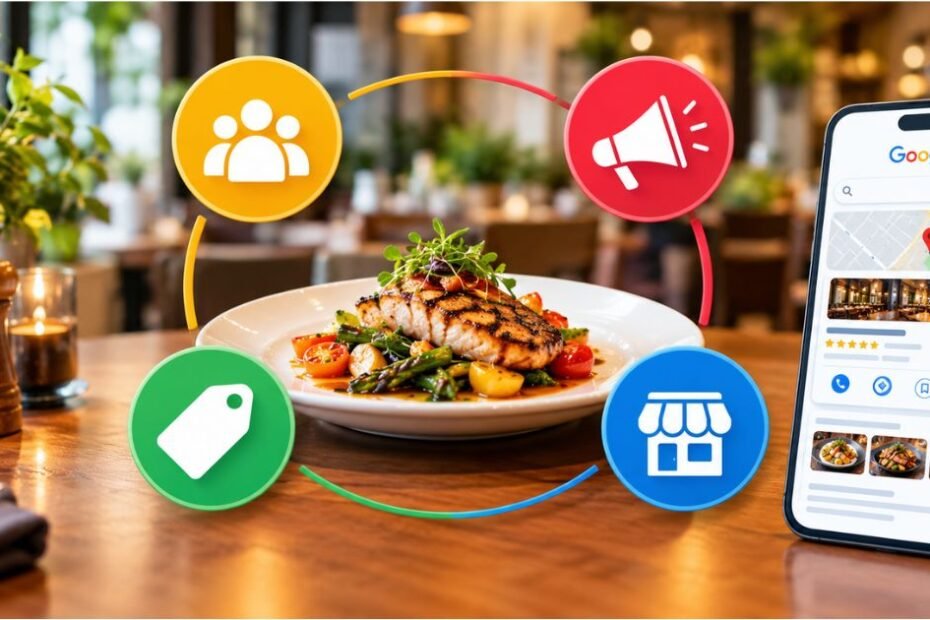
How to Rank a Restaurant on Google? To rank a restaurant on Google, fully complete and verify your Google Business Profile, earn a steady flow of genuine reviews, keep a crawlable website with a text menu, and keep your name, address and phone number consistent across the web. Google says local results depend mainly on relevance, distance and prominence. Results vary by searcher location, and no one can guarantee a specific position.
Where Can Your Restaurant Rank on Google?
“Ranking on Google” means three different things. Each has its own levers.
| Where you show up | What it looks like | What moves it most |
| Map Pack / Google Maps | The map with three restaurants at the top of local searches | Your Google Business Profile, reviews, location |
| Regular search results | Blue links to websites | Your website, content, links |
| AI answers | Google’s AI features, such as Ask Maps and AI Mode, and tools like ChatGPT recommending places | Profile completeness, review content, attributes, photos, consistent info across the web |
Most restaurants only chase the first. The best-ranked ones work on all three, because the same four ingredients feed every surface. For the regular-search side of that equation, our How to Increase SEO Ranking: 2026 Framework + Checklist covers the fundamentals in detail.
Those ingredients are the 4P Plate:
- Profile: what Google reads about you.
- Proof: your reviews.
- Pages: your website.
- Presence: your mentions and listings elsewhere.
How Does Google Decide Which Restaurants to Show?
Google has said it plainly. Local results are based primarily on relevance, distance, and prominence.
Here are the three in one-line definitions:
- Relevance: how well your profile matches what the person typed.
- Distance: how far you are from the person searching.
- Prominence: how well-known and trusted your business is. Prominence draws on information from across the web, such as links, articles and directories, and Google review count and score also factor in. Earning those links and mentions is part of the wider approach in our 6 Ways to Improve Your Site’s SEO Rankings.
What you can’t control
You can’t move your building. Someone two blocks away may see a different list than someone across town. That’s why a competitor can look like they “always” outrank you. They may simply be closer to the person searching.
You also can’t buy your way up. Google states that there is no way to request or pay for a better local ranking. Anyone selling you a guaranteed spot is selling something Google says doesn’t exist.
So you win on the two things you can shape: relevance and prominence. The rest of this guide is about exactly that.
How long does it take to rank higher?
Nobody can promise a timeline, because rankings depend on your competition and location. One restaurant-SEO vendor suggests you may see measurable movement in about 4–8 weeks, with sustained gains taking 3–6 months. Treat that as a vendor estimate, not a Google rule.
A healthy expectation: quick wins in the first month (fixing your profile), momentum over a few months (reviews pile up). Real growth is a habit, not a one-time project.
P1: Profile. How Do You Set Up Your Google Business Profile to Rank?
Your Google Business Profile (GBP) is the free listing that shows your photos, reviews, hours, menu link and directions. It’s the single most important asset you own for Maps. Google advises that your business info should be accurate, complete and engaging to show up more often. Our Virginia Local SEO guide goes deeper on the broader local-search fundamentals behind a strong profile, and its principles apply well beyond Virginia.
Work through these steps in order.
- Claim and verify your listing. Unverified profiles are far less likely to show up. Verify before you touch anything else.
- Choose the most specific primary category. This is one of the strongest relevance signals. If you run an Italian restaurant, choose “Italian restaurant,” not just “Restaurant.” Then add secondary categories that truly describe you (for example, pizza restaurant or wine bar). Don’t add categories you don’t really offer.
- Fill in every attribute that’s true. Outdoor seating, vegan options, good for kids, live music, takeout, reservations. These matter more than ever in AI-driven search. When a diner asks for a specific need, a restaurant that never ticked that box can be filtered out. (This is a logical inference from how conversational search matches requirements; Google hasn’t published the exact filtering rules.)
- Add a real menu link. Link to a web page with text, not a photo. More on that in P3.
- Keep hours exact, including holidays. Wrong hours are the fastest way to lose trust and customers. Google has also been said to weigh whether a business is open at the time of search, so special hours matter.
- Upload real photos regularly. Food, interior, exterior, your team. Use your own photos, not stock images. Add new ones often. An actively managed profile looks alive to both Google and diners.
- Write a clear description. Say what you serve, your neighborhood and what makes you different, in natural language. Don’t stuff keywords.
Name rules that prevent suspension
Use your real business name, exactly as it appears on your sign. Adding “Best Pizza Brooklyn” to your name field is a classic violation. Industry analyses describe keyword stuffing in business names as one of the clearest spam signals.
One analysis of suspended profiles found that 42 percent involved address verification failures, 28 percent business name issues and 17 percent review manipulation. That’s one firm’s sample, not a Google statistic. But the lesson holds. Most suspensions are boring, avoidable data problems.
P2: Proof. How Many Google Reviews Does a Restaurant Need to Rank?
There’s no official number. Google confirms that review count and review score factor into local ranking. Common industry benchmarks are 100+ reviews and a 4.0+ rating. As DoorDash’s own guide admits, these benchmarks don’t trace to a single official Google source. Use them as direction, not law.
What matters beyond the totals:
- Quantity: more genuine reviews build credibility.
- Quality: a strong average rating helps both ranking and trust.
- Recency: a steady trickle beats a burst followed by silence.
- Content: what reviewers actually say.
Policy-safe ways to ask for reviews
This is where many restaurants accidentally hurt themselves. Two popular tips floating around the web conflict with Google’s rules.
Allowed (the safe core):
- Ask every customer, not just happy ones.
- Share your direct review link. In your GBP dashboard, find the “get more reviews” option and copy the link.
- Put that link in follow-up texts, emails and receipts, and train staff to mention it naturally.
- Accept whatever the customer writes, good or bad.
Not allowed:
- Incentives of any kind. Google’s policy prohibits offering payment, discounts, free goods or services in exchange for a review. That includes “spin the wheel” games and free dessert for five stars.
- Review gating. Sending the review link only to customers you expect to be happy. A private feedback survey is fine as a service tool, but don’t use it as a filter that decides who sees the Google link.
- Fake or insider reviews from staff, family or friends.
Newer rules to verify. Industry reports say Google updated its Maps policy in April 2026 to explicitly restrict staff review quotas and asking customers to mention employee names. Other sources report that on-premises review kiosks are also against policy. These come from secondary reporting. Before you set up table QR codes or staff incentives, check Google’s current Maps User Generated Content Policy yourself. When in doubt, the safest approach is a simple, equal, no-strings request.
The stakes are real. Reports citing Google’s 2025 Trust & Safety data say over 292 million policy-violating reviews were blocked or removed in 2025. Penalties can range from review removal to profile restrictions.
How to reply to reviews (and what’s a myth)
Google says positive reviews and helpful replies can help your business stand out. That’s the supported claim.
What I couldn’t find a Google source for: claims that replying within 72 hours mathematically lifts your star average, or that keyword-packed replies boost rankings. Don’t build your strategy on those.
Do this instead:
- Thank the reviewer and mention something specific (a dish, the occasion).
- For negative reviews: acknowledge, apologize briefly, and offer to fix it offline. Don’t argue in public.
- Reply on a schedule. Block 15–20 minutes, two or three times a week.
- Write like a human. Future diners are reading your replies too.
The Review Specificity Test (original)
Here’s a quick check that most guides skip. Open your last 10 reviews and ask:
Would a stranger know your best dish, your vibe, and who your restaurant is good for?
If your reviews all say “Great food! Will come again!”, they prove you’re real, but they give AI systems almost nothing to match against a detailed question like “quiet Italian place with gluten-free pasta.” Some vendors claim that 80 detailed reviews can outperform 300 generic ones in AI recommendations. That’s an unverified vendor claim, but the logic is sound.
What you can do ethically: you can’t script reviews or tell guests what to write. But you can make your restaurant distinctive so there’s something specific to say, and you can ask open-ended questions at the table (“What did you love most tonight?”) so guests are thinking about specifics when they do review.
P3: Pages. Do You Need a Website to Rank?
Short answer: no, but it helps a lot. You can show up in Maps with only a Google Business Profile. But a good website gives Google more proof of who you are, where you are and what you serve.
Do these four things:
- Put your menu in real text. Restaurant Den makes the point that menus that exist only as an image or PDF are hard for search engines to understand. A text menu connects your restaurant to dishes people actually search for.
- Make your homepage state three things clearly: your cuisine, your neighborhood, and your style (casual, fine dining, family-friendly).
- Add pages for what you offer: menu, reservations, private dining, catering.
- Add Restaurant schema markup. This is code that tells Google your name, address, hours, menu and cuisine in a machine-readable way. Your web developer or website platform can usually add it in minutes. Our guide to Schema Markup for SEO walks through how to implement it correctly.
Keep the site fast on mobile. Most diners will land on it from a phone, often while standing on a sidewalk deciding where to eat. If your pages load slowly, those diners will hit back and pick someone else our Website Speed Optimization Services guide covers what actually moves load times.
P4: Presence. Do Citations and Third-Party Sites Matter?
Yes, because Google cross-checks you across the web. If your hours or phone number differ between your website, Yelp, Facebook, DoorDash and Google, that creates doubt. As Restaurant Den puts it, matching information across sites makes it easier for Google to recognize them all as the same restaurant. If you run more than one location, our guide to Local SEO for Multiple Locations covers keeping listings consistent branch by branch.
Your Presence checklist:
- NAP consistency: same name, address and phone, written the same way everywhere (“Street” vs. “St.” mismatches have been flagged as a confusion risk).
- Core listings: Apple Maps, Bing Places, Yelp, TripAdvisor.
- Delivery and reservation platforms: keep menus and hours current.
- Local mentions: food bloggers, local news, community event pages. These build the “well-known” side of prominence.
Why third-party sites matter for AI. DoorDash reports, citing Yext, that restaurant listing sites make up over 41% of the sources AI tools cite when recommending restaurants. That figure comes from a vendor report, so treat it as directional. The takeaway is still useful: keep every platform accurate, because AI tools may read them all.
How Do You Get Recommended by Google’s AI and ChatGPT?
Search is shifting from lists to conversations. Google’s Ask Maps, powered by Gemini, launched March 12, 2026 in the U.S. Instead of typing “Italian restaurant downtown,” diners can now ask for a quiet place with vegetarian options near the East Side by 7 p.m. Industry sources say the AI draws on profile data, reviews, photos and attributes to answer. Google’s AI Mode also can show place cards with ratings and reviews.
Nobody outside Google knows exactly how these systems choose. But you can raise your odds with the same 4P work, aimed more precisely:
- Complete every attribute that’s true for you.
- Make your photos tell the story of your vibe (cozy, lively, romantic).
- Earn reviews with real detail (see the Review Specificity Test).
- Keep your info identical everywhere AI tools may read it.
- Describe your restaurant clearly on your website, in plain sentences that answer likely questions.
No tactic guarantees a recommendation. Accurate, specific, consistent information gives you the best odds.
How Do You Measure Your Restaurant’s Ranking?
Most owners test by searching their own name. That’s misleading, because Google personalizes results and distance changes everything.
Track these instead:
- GBP Performance insights. See how many people found you by search, by Maps, and how many called, asked for directions or clicked your website.
- Google Search Console for your website’s organic clicks and queries. If you also use Google Analytics alongside it, our comparison of GA4 Sessions vs GSC Clicks explains why the two reports rarely show the same numbers.
- Searches from different locations. Check how you appear from a few blocks away in different directions, since distance changes the list. Paid grid-based rank trackers automate this.
- A simple monthly log: review count, average rating, newest review date, profile views, direction requests.
Pick two or three numbers and watch the trend. That’s how you’ll know what’s working.
What If Your Rating Is Already Low or a Review Is Fake?

A low rating isn’t a life sentence. Respond professionally, fix the real problems reviewers mention, and keep earning new genuine reviews. Recent reviews carry weight in how people judge you, and a stream of fresh, honest feedback gradually reshapes the picture.
You can’t remove a review just because it’s unfair or negative. You can flag reviews that break Google’s rules, such as spam, fake content, or content that isn’t about a real experience. Document your case and use the “report review” option in your dashboard.
Never fight fake reviews by posting fake ones. That’s the fastest path to a suspension.
Conclusion
Ranking a restaurant on Google in 2026 requires more than creating a Google Business Profile. The 4P Plate Method—Profile, Photos, Posts, and Proximity—provides a practical framework for improving local visibility, attracting nearby customers, and building trust online. Keep your business information accurate, upload high-quality food and restaurant photos, publish relevant updates, and encourage genuine customer reviews. Combine these efforts with local SEO, consistent business details, and a user-friendly website to strengthen your restaurant’s online presence. While rankings depend on competition, relevance, distance, and prominence, consistent optimization can help your restaurant reach more potential customers and generate more visits and reservations.
FAQs
How many Google reviews does a restaurant need to rank?
There’s no official number. Google says review count and score factor into local ranking, and common industry benchmarks are 100+ reviews and a 4.0+ rating. Steady, recent, genuine reviews matter more than a one-time spike.
How long does it take to rank higher on Google Maps?
It varies by competition and location, and no one can promise a timeline. Vendor estimates suggest early improvement within weeks and sustained gains over several months. Fixing profile errors is usually the quickest win.
Can I rank without a website?
Yes, you can appear in Maps with only a Google Business Profile. But a website with a text menu and Restaurant schema gives Google more information and can improve both Maps and search visibility.
Can I give customers a discount for leaving a review?
No. Google’s policy prohibits offering payment, discounts or free goods in exchange for reviews. Violations can lead to review removal or profile restrictions.
Why does my competitor rank above me in “near me” searches?
Distance, relevance and prominence all play a part, and the list changes depending on where the searcher is standing. Your competitor may be closer, have more detailed reviews, or have a more complete profile.
Can I pay Google to rank higher in local results?
No. Google states there is no way to request or pay for a better local ranking. Paid ads are separate and appear labeled as ads.
How do I get my restaurant recommended by Google’s AI or ChatGPT?
No one can guarantee it. Complete every profile attribute, upload real photos, earn detailed reviews, and keep your information identical across your website and listings. Accurate, specific, consistent data gives AI tools the most to work with.
