
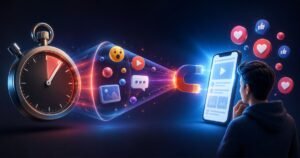
Scroll through any feed for ten seconds and you’ll see it: a flat photo, another flat photo, then suddenly something moves and your thumb stops. That pause is worth more to a brand than almost anything else in social media marketing, because it’s the moment before someone decides whether to keep scrolling or start paying attention.
Animation in social media marketing is the use of moving graphics, characters, or text from short GIFs to full explainer videos to communicate a brand’s message across platforms like Instagram, TikTok, YouTube, and LinkedIn. It works because movement naturally draws the eye, and because animation can simplify ideas that would take paragraphs of text to explain. Brands use it to introduce products, explain services, and build a visual identity that’s instantly recognizable, even with the sound off. One of the many proven benefits of social media marketing that businesses tap into every day.
What Is Animation in Social Media Marketing?
Animation in social media marketing is the practice of using motion through 2D or 3D graphics, animated text, GIFs, or hybrid live-action/animated footage to deliver a brand message on social platforms. Instead of a static photo or a block of text, animation adds rhythm and visual storytelling that’s built specifically for how people scroll: fast, distracted, and quick to judge.
It shows up in a lot of forms. A looping GIF reacting to a trending moment. A 15-second animated explainer breaking down a product feature. A kinetic-typography quote overlaying a founder’s voiceover. What ties them together is motion doing work that a still image can’t: guiding attention, compressing a complex idea into something visual, and giving a brand a consistent “feel” across every post. If you’re still mapping out the basics of the channel itself, our complete beginner’s guide to social media marketing is a good place to start before layering animation on top.
Why Animation Works on Social Media
The Attention Problem Animation Solves
Social feeds are engineered around a brutally short attention window most platforms’ algorithms weigh how long someone stays on a piece of content within its first few seconds, which is exactly why the opening of any post matters disproportionately. A static image has to earn attention through composition and color alone. Animation earns it through motion itself: the human eye is wired to notice movement before it processes anything else on a screen, which is why an animated post tends to interrupt a scroll more reliably than a still one.
That interruption isn’t the whole story, though it just buys you the next few seconds. What a brand does with that attention (a clear idea, a recognizable style, a reason to keep watching) determines whether the interruption turns into engagement. This is exactly the kind of thinking behind a solid social media marketing strategy attention is only step one.
Animation and Message Retention
Beyond grabbing attention, animation tends to help people remember what they saw. Combining a visual with motion and, often, a short narrative arc gives the brain more than one way to encode the message compared with text alone, which relies on a single channel. This is one reason explainer-style animation is so common for products or services that are hard to describe in a sentence: showing how something works, rather than describing it, shortens the distance between seeing an ad and understanding the offer.
Animation increases customer engagement because its movement, color, and pacing create a more immersive, harder-to-ignore experience than static content and that immersion is what turns a passive scroll into an active watch. It’s one of several reasons why SMM is so powerful for brands trying to stand out in a crowded feed.
Animation vs. Static Images vs. Live-Action Video
None of these formats is universally “best” the right choice depends on budget, message complexity, and how much control you need over the final look. Here’s how they compare on the factors that matter most for social content decisions.
| Factor | Animation | Static Images | Live-Action Video |
| Attention-grabbing power | High motion interrupts the scroll | Moderate relies on composition/color | High but competes with authenticity expectations |
| Best for | Explaining processes, abstract concepts, brand storytelling | Product shots, quotes, quick announcements | Testimonials, behind-the-scenes, real demonstrations |
| Production cost | Low–moderate (no locations, actors, or reshoots) | Lowest | Highest (crew, location, talent, editing) |
| Time to produce | Days to a few weeks, depending on complexity | Hours | Days to weeks (shoot + edit) |
| Update/edit flexibility | High often just re-render a scene | High swap the image | Low usually requires a reshoot |
| Emotional authenticity | Moderate depends on style and voice | Low | Highest real faces, real settings |
| Platform fit | Strong across Reels, TikTok, Shorts, LinkedIn | Strong on Instagram feed, X, Pinterest | Strong on YouTube, Reels, TikTok |
Estimate, not verified data: cost and production-time ranges above are general industry patterns compiled from publicly available agency pricing pages, not a single verified study actual costs vary significantly by studio, region, and animation complexity.
The practical takeaway: animation tends to win when the message is conceptual (how a service works, what a feature does) or when a brand wants full creative control without location or casting constraints. Live-action tends to win when authenticity and real human faces are the point testimonials, founder stories, unscripted moments.
Types of Animation for Social Media
Not every style fits every message. Here’s a quick breakdown of the main categories brands use on social platforms, and when each one earns its place.
2D animation is flat, illustrated motion think animated characters, icons, or scenes moving across a two-dimensional plane. It’s the most common style for explainer content because it’s fast to produce, easy to brand with consistent colors and characters, and clear enough to communicate a process step-by-step.
3D animation adds depth and realism through three-dimensional modeling. It’s typically reserved for product demos, architectural or spatial concepts, and situations where showing an object from multiple angles matters it costs more to produce but can make a product feel tangible without a physical shoot.
Stop motion uses physical objects photographed frame-by-frame to simulate movement. It has a handmade, tactile quality that reads as more playful or nostalgic than digital styles, which makes it a strong fit for product unboxings or craft-oriented brands.
GIFs and cinemagraphs are short, looping animations a GIF typically loops a full sequence, while a cinemagraph keeps most of the frame still with just one moving element. Both are built for speed: quick to load, quick to understand, and easy to reuse across platforms and even direct messages.
Whiteboard animation simulates a hand drawing or writing content in real time. It’s especially effective for step-by-step or educational content, because the “in-progress” feel mimics how a person would naturally explain something on a whiteboard.
Hybrid (live-action + animation) blends real footage with animated overlays text callouts, graphic elements, or small animated characters layered onto live video. This combines the authenticity of real footage with animation’s ability to clarify or emphasize a specific point, without the cost of a fully animated production.
Platform-by-Platform Animation Specs
The same animation rarely performs the same way on every platform, because each one has different aspect ratios, sound-on/sound-off habits, and audience expectations. Use this as a starting checklist before you brief a production or before handing it off to a team running your social media marketing packages.
| Platform | Ideal Length | Aspect Ratio | Sound-Off Design | Best Animation Style |
| Instagram Reels | 7–15 sec (up to 90 sec for storytelling) | 9:16 (vertical) | Captions essential | 2D, hybrid, kinetic text |
| TikTok | 9–15 sec (up to 60 sec) | 9:16 (vertical) | Captions essential | 2D, stop motion, meme-style GIF-adjacent |
| YouTube Shorts | Under 60 sec | 9:16 (vertical) | Captions recommended | 2D explainer, hybrid |
| YouTube (standard) | 60–120 sec for explainers | 16:9 (horizontal) | Optional but improves reach | 2D/3D explainer, whiteboard |
| 30–90 sec | 1:1 or 16:9 | Captions essential (largely sound-off audience) | 2D, whiteboard, data-driven motion graphics | |
| X (Twitter) | Under 30 sec | 1:1 or 16:9 | Captions recommended | GIF, short 2D loop |
Estimate, not verified data: these ranges reflect commonly cited platform best practices as of 2026 and general industry consensus, not official platform mandates check each platform’s current creator or ads guidelines before finalizing specs, since these can shift.
A large share of video views on social platforms happen with the sound muted, especially in public settings which is why captions and on-screen text aren’t optional extras for animated content; they’re part of the core design, not an afterthought layered on at the end.
Real Brand Examples & Case Studies
Looking at how established brands have actually used animation shows the range of what’s possible from simplifying a technical product to building an entire seasonal tradition around motion graphics.
Dropbox built its early social media presence partly around short, looping GIFs that demonstrated specific product features drag-and-drop syncing, file sharing in just a few seconds. The format let a fairly abstract cloud-storage concept become instantly visual and shareable.
MailChimp used playful 2D animation to explain email marketing concepts that are otherwise dense and technical, turning what could be a dry how-to into something closer to entertainment. This pairing of education and personality is a big part of why the brand’s animated content became recognizable on its own.
Spotify’s annual “Wrapped” campaign is one of the most-cited examples of animation used at scale for personalization animated, shareable summaries of each listener’s year, built to be posted directly to Stories and feeds. It turned a data recap into a social media moment that users voluntarily distribute for the brand.
Duolingo leans heavily on a recognizable animated mascot across short-form video, using consistent character animation to build a personality-driven presence that performs well specifically because the character (not the product) is the hook.
These examples share a pattern worth noting: the animation isn’t decorative. In each case, it’s doing a specific job simplifying a feature, personalizing data, or carrying a brand’s personality rather than existing just to look polished.
E-E-A-T note for brand use: if you have first-party campaign data (view counts, conversion lift, engagement rate before/after adopting animation), that data should replace or supplement these public examples first-party results are always stronger proof than third-party case studies.
Tools & Cost DIY vs. AI vs. Hiring an Agency

Budget is usually the deciding factor in how a brand approaches animation, and there are three realistic paths.
DIY with design tools. Platforms like Canva and Adobe Express offer template-based animation builders aimed at non-designers drag in text, apply a motion preset, export. This is the lowest-cost path and works well for simple kinetic-text posts or basic branded graphics, but it has a visible ceiling: templates tend to look like templates.
AI-assisted animation tools. A newer category of AI video and animation generators can produce short animated clips from text prompts or static assets, compressing what used to take days into hours. This is worth testing for high-volume, lower-stakes content (daily social posts, quick promos), but as of 2026, output quality and brand consistency still vary significantly between tools, and most brands still want a human pass for anything customer-facing at scale.
Hiring a professional animator or studio. For a defining brand asset an explainer video, a recurring animated series, a mascot professional production still delivers the most consistent, polished, and strategically aligned result. It costs more and takes longer, but it’s the path most established brands (Dropbox, MailChimp, Spotify) used for their signature animated content. If you’d rather compare providers than build in-house, our roundup of top digital marketing agencies in the USA is a useful starting point, and our guide to affordable social media management for small businesses breaks down realistic pricing for outsourced content work.
A simple way to decide: use DIY or AI tools for volume and speed; use a professional studio for anything meant to represent your brand long-term.
Estimate, not verified data: published rates for short-form social animation (under 60 seconds) commonly range from a few hundred dollars for template-based DIY work up to several thousand dollars for custom professional 2D or 3D production actual pricing depends heavily on studio, complexity, and revision scope, so treat any number here as a planning estimate, not a quote.
How to Measure ROI
Animation only earns its place in a content strategy if it’s actually moving the numbers that matter. Track these in order of what they reveal:
- Engagement rate (likes, comments, shares, saves relative to reach) the first signal that the content is resonating, not just being seen.
- Watch time / completion rate for video-based animation specifically, this shows whether the opening hook is working and whether people stay through the message.
- Click-through rate if the goal is driving traffic, this measures whether the animation actually motivates action, not just attention.
- Conversion rate the deepest signal: did the animated content lead to a sign-up, purchase, or other defined action.
- Brand recall / mentions harder to measure directly, but spikes in branded search or social mentions after a campaign can indicate the content is sticking.
A simple starting formula: compare engagement rate and completion rate for your animated posts against your account’s average for static or live-action posts over the same period. If animation consistently outperforms your baseline, it’s earning its production cost. If it doesn’t, the issue is usually the message or hook not the format itself. Pairing this tracking with the right social media marketing tools makes it much easier to compare formats side by side.
Common Mistakes to Avoid
- Ignoring platform specs. A horizontal explainer video dropped into a vertical Reels slot loses most of its visual real estate and looks like an afterthought.
- No captions. Given how much social video is watched on mute, skipping captions means losing the message for a large share of your audience before it even starts.
- Overloading the first three seconds. Trying to say too much at once in the opening beat defeats the purpose of using motion to simplify.
- Inconsistent branding across posts. If every animated post uses a different color palette or style, none of them build recognizable brand equity over time.
- Treating animation as automatically better. Animation is a tool suited to specific messages (process, concept, personality) forcing it onto content that would work better as a real testimonial or a simple product photo wastes budget without adding value.
The 3-Second Hook Framework
Most guidance on social animation stops at “grab attention fast,” without giving marketers a repeatable structure to actually do it. Here’s a simple framework worth applying to any animated social post:
- Hook (0–3 seconds): Open with the single most visually interesting frame of the entire piece not a logo, not a slow build. If someone only sees three seconds, that moment should already communicate the core idea or spark curiosity.
- One Idea (middle): Resist the urge to explain every feature or benefit. Pick the single idea that matters most for this specific post, and let the rest of your content calendar cover the others.
- One CTA (final beat): End on one clear, singular action not a list of options. “Learn more,” “Save this,” “Tap to shop” pick one, and make sure the last visual frame supports it.
This isn’t a universal law of animation, but it’s a useful discipline: most underperforming animated content fails not because the motion design is weak, but because it tries to do too much in too little time.
Conclusion
Animation can make social media marketing more engaging, memorable, and effective in 2026. From short animated videos and product explainers to motion graphics and social ads, businesses can use animation to capture attention and communicate ideas quickly. The key is to match the animation style with your audience, platform, brand identity, and marketing goals.
If you’re building (or rebuilding) your approach from scratch, start with our guides on what social media marketing actually is, social media marketing for small business, and the best social media marketing software for small business to pick the right tools before you brief your first animated post.
FAQs
Why is animation important in social media marketing?
Animation captures attention faster than static content because the eye naturally follows movement, and it can simplify complex ideas into something visual and easy to understand. That combination tends to drive stronger engagement and better message retention than plain text or photos alone.
What types of animation work best on social media?
2D animation is the most versatile and cost-effective for explainer-style content, while GIFs and cinemagraphs work well for quick, high-shareability posts. The right choice depends on your message: use 3D for product depth, whiteboard for step-by-step education, and hybrid live-action for authenticity with clarity added on top.
How much does social media animation cost?
Costs range widely, from free or low-cost DIY template tools to several thousand dollars for custom professional production. As a planning estimate, short-form professional animation (under 60 seconds) commonly falls in the low-to-mid thousands, though this varies by studio and complexity.
How long should an animated social media video be?
Most platforms reward short-form animation between 7 and 30 seconds, though YouTube and LinkedIn can support up to 90–120 seconds for more detailed explainer content. The goal isn’t length it’s making sure every second earns the viewer’s continued attention.
Is animation more effective than static images on social media?
Animation generally drives stronger attention and retention because of movement’s natural pull on the eye, but it isn’t automatically “better” static images are faster and cheaper to produce and still perform well for simple announcements or product shots. The right format depends on the message and the budget.
What software do you need to make animated social media content?
For DIY work, tools like Canva or Adobe Express offer accessible animation templates. For custom or brand-defining content, professional tools like Adobe After Effects, Toon Boom Harmony, or Blender (free, open-source) are standard, often alongside a professional animator or studio.
