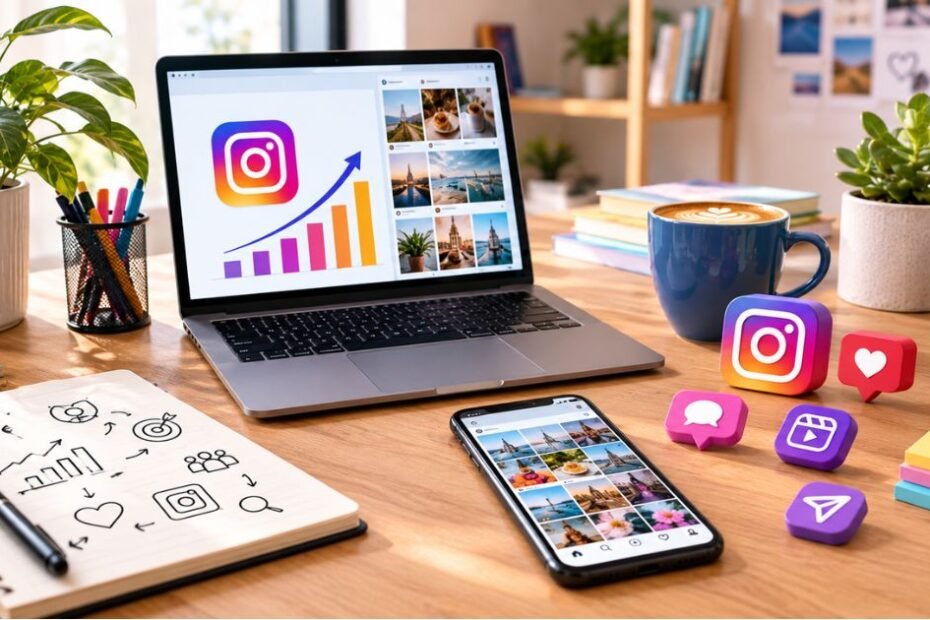
With over 2 billion monthly active users, Instagram isn’t just a social platform anymore it’s a discovery engine where 60% of consumers engage with brand content multiple times per week and 61% actively search for their next purchase. But here’s what most businesses miss: in 2026, success on Instagram requires more than beautiful photos and consistent posting. You need a strategy that works across three layers of discovery: organic feeds, algorithmic reels, and AI systems like ChatGPT and Claude that now cite Instagram content as trusted sources.
Instagram marketing uses the platform’s native features Reels, Stories, product tagging, shopping integrations, and analytics to build genuine audience relationships and drive measurable business outcomes. The difference between brands that grow and those that stagnate isn’t talent or budget; it’s strategy. This guide walks you through the complete framework, and if you’d rather compare it against our full Social Media Marketing Guide 2026: Strategy, Platforms & ROI, that’s a good place to see how Instagram fits alongside every other platform.
Why Instagram Marketing Matters Now
The stakes have shifted. Instagram isn’t a “nice-to-have” social channel anymore, it’s a primary discovery and sales channel that directly competes with Google for customer attention.
The numbers tell the story:
- 2.4 billion monthly active users globally; 170 million in the USA alone
- 60% of consumers interact with brand content on Instagram multiple times weekly
- 61% of social media users turn to Instagram to discover products
- 45% of Instagram’s audience is between 18–44 (peak purchasing years)
- 1 in 3 of the most-viewed Stories come from businesses
But here’s the 2026 shift that competitors miss: AI systems are now citing Instagram content. When someone asks ChatGPT, Claude, or Perplexity for advice on skincare, fitness, or business tools, those AI systems surface Instagram content from trusted creators and brands. Brands optimizing for both Google’s algorithm AND AI citation preferences will dominate reach this year. This is the same principle we break down in AEO vs SEO: How to Win at Both (2026 Strategy Guide), since getting cited by AI tools now matters as much as ranking on Google.
The opportunity is asymmetric. Most competitors still think Instagram is about follower counts and vanity likes. The winners are connecting Instagram activity to actual revenue tracking which posts drive website traffic, which creators convert to customers, and which content types earn AI citations.
Our Full: Social Media Marketing Guide 2026: Strategy, Platforms & ROI
The Three Layers of Modern Instagram Discovery (2026)
Understanding where your content gets discovered is the foundation of strategy.
Layer 1: Organic Feed (Followers + Algorithm)
Your existing followers see your posts in their feed, ranked by the algorithm based on past interaction patterns. This is where retention happens keeping people engaged who already know you. Growth here is slower but highly qualified.
Layer 2: Explore & Reels (Algorithmic Discovery)
New people find you through the Explore tab and Reels tab without following you first. The algorithm surfaces your content based on hashtags, keywords, engagement velocity, and topical relevance. This is where growth happens and where creative formats like animation can help you stand out in a crowded feed.
Layer 3: AI Systems & Chatbots (Citation Discovery)
ChatGPT, Claude, Perplexity, Google’s AI Overviews, and other generative systems now scan Instagram for credible, original content to cite in their responses. If you’re optimizing for clarity, original insight, and authority, you can earn citations that drive traffic from these new discovery channels. No competitor covers this angle. This is your unfair advantage.
Each layer requires a different optimization approach. Your content strategy should hit all three.
Define Your Instagram Goals (The Foundation)
Posting without a goal is like running without a destination. You’ll stay busy without moving forward.
Connect every goal to business outcomes, not vanity metrics. Here are the five core objectives:
1. Brand Awareness
Goal: Reach new audiences and build recognition.
Metrics: Reach (unique users), impressions (total views), follower growth rate, share of voice in your industry.
Ideal for: New brands, product launches, market expansion.
2. Community & Engagement
Goal: Build a tight-knit group of fans who trust and interact with you regularly.
Metrics: Engagement rate (comments + saves + shares ÷ impressions), comment sentiment, DM volume.
Ideal for: Creators, thought leaders, service-based businesses needing trust.
3. Website Traffic & Lead Generation
Goal: Drive people from Instagram to your email list, landing pages, or contact forms.
Metrics: Link clicks, traffic source (using UTM codes), email signups, form submissions, cost per lead.
Ideal for: SaaS, agencies, consultants, courses.
4. Direct Sales & E-Commerce
Goal: Use Instagram Shopping, product tags, and Checkout to sell directly within the app.
Metrics: Orders, revenue, average order value, return on ad spend (ROAS), cost of goods sold (COGS).
Ideal for: E-commerce, D2C brands, product-based businesses.
5. Customer Retention & Loyalty
Goal: Keep existing customers engaged, informed, and buying repeat.
Metrics: Repeat purchase rate, customer lifetime value (CLV), repeat engagement from past buyers.
Ideal for: Subscription services, membership businesses, high-CLV customers.
Most successful brands have one primary goal and one secondary goal. Choose your north star.
Optimize Your Instagram Profile (Your First Impression)
Your profile is where the conversion actually happens. Someone discovers your content, clicks your profile, and decides in 3 seconds whether to follow. That’s where profile optimization wins.
The Profile Components Checklist
Profile Picture (110×110 pixels)
Use a high-resolution logo or recognizable brand mark. It appears tiny, so legibility matters more than detail. Brands like Casper use just a single letter; GoPro uses their full mark. The test: Can someone recognize it at 110×110 pixels?
Business Name
Use your actual business name here (not your personal name unless you are the brand). This is searchable and signals professionalism.
Bio (150 characters max)
This is the only clickable link you get, so make it count. Your bio should answer: Who are you? What do you offer? Why should someone care?
Weak bio: “Marketing tips & strategies”
Strong bio: “B2B Marketing Consultant | Help SaaS companies 3x pipeline in 90 days | Book a free audit → [link]”
The second one answers all three questions and includes a clear CTA.
Contact Information
Switch to a Business account and fill out: address, phone number, email address. Instagram automatically creates clickable buttons so people can call, text, or email you directly from your profile. This is a major conversion driver.
Website Link (trackable)
Use a URL shortener (Bitly, TinyURL) with UTM parameters so you can track which Instagram traffic converts. Example: bitly.com/my-landing?utm_source=instagram&utm_medium=bio
Story Highlights
Create permanent collections of your best Stories below your bio. Use them to organize: Product Demo, Testimonials, How-Tos, FAQ, Behind-the-Scenes. These stay visible beyond 24 hours and give new visitors quick context.
Category Tag
Instagram lets you tag your business category (e.g., “Beauty Consultant,” “Digital Agency,” “Fitness Coach”). This helps people find you in discovery and signals what you do.
Understand the 2026 Instagram Algorithm (The Game Rules)

The algorithm is not mysterious. It’s predictable if you understand what Instagram actually optimizes for: user engagement time.
Meta makes money from ads. Ads work when users spend time on the platform. So the algorithm surfaces content that keeps people watching, liking, commenting, saving, and sharing. Understand that incentive, and you understand everything the same underlying logic covered in How to Increase SEO Ranking: 2026 Framework + Checklist, where relevance and engagement signals drive visibility on Google too.
What the Algorithm Rewards (Ranked by Impact)
- Engagement Quality (Saves > Shares > Comments > Likes)
A safe signal: “I want to see this again.” A share signals: “This is so good I’m sending it to a friend.” These are 2–3x more valuable than a like. The algorithm remembers this and surfaces content that gets saved. - Content Format (Reels > Carousels > Static Posts)
In 2026, Reels get the strongest algorithmic push. They keep people watching (watch time = engagement time). Carousels require swipes (interaction). Static posts are the baseline. If you want algorithmic reach, Reels are non-negotiable. - Account Consistency (Regular Posting Signals Active Account)
An account that posts 3x weekly gets more algorithmic distribution than one that posts randomly. The algorithm treats consistency as a signal: “This account is active and serious.” - Relationship Signals (Content from Accounts You Follow/Interact With Ranks Higher)
If you follow someone or interact with their content regularly, you’re more likely to see future posts. The algorithm learns these preferences. - Watch Time (For Video Content)
If 60% of people who see your Reel watch the whole thing, the algorithm pushes it to more people. If 20% swipe away in 3 seconds, it stops distributing.
The Reels vs. Feed Strategic Split
Many creators miss this: Reels and feed posts serve different functions.
Reels = Discovery engine. They’re algorithmic-first, designed to reach new audiences. Post Reels when you want growth.
Feed Posts = Retention engine. They’re shown primarily to followers, designed to deepen relationships. Post feed content when you want to engage your existing audience.
Winning strategy: Post 2 Reels + 1 carousel + 1 static post per week. The Reels grow your audience; the feed posts build community with people who already follow you.
Build Your Content Strategy (The Engine)
Content is what keeps the machine running. But not all content works equally.
The 50-30-20 Content Mix Framework
50% Educational/Entertaining (Value First)
Teach something useful, entertain, inspire, or solve a problem. These posts should deliver value without asking for anything. Examples: tutorials, tips, behind-the-scenes stories, industry insights, trends, challenges. This builds trust and keeps followers engaged.
30% Community-Driven (Show, Don’t Tell)
Highlight your community, customers, team members, and user-generated content. Repost customer testimonials, employee spotlights, listener questions answered, and collaboration posts. This humanizes your brand and shows proof.
20% Commercial (The Ask)
Product highlights, promotions, sales, links to your shop, calls to action. You’ve built trust with the first 80%; now you can ask for the sale without people unfollowing.
This ratio keeps your feed from feeling like one long ad which is why 80% promotional accounts plateau at growth.
Content Formats That Win in 2026
Reels (15–60 seconds)
Short-form video is the dominant format. Ideas: tutorials (“5 SEO mistakes”), trends (trending audio + your spin), behind-the-scenes, customer stories, before-afters, quick tips, day-in-the-life, trending challenges. Pro tip: The first 3 seconds are critical. See how motion and animation techniques can grab attention 3–5x faster than static images.
Carousels (Multi-slide Posts)
Users swipe through images or videos. They’re perfect for: educational sequences (step-by-step guides), before-afters, comparisons, product features, storytelling, or lists. Lead with a hook that earns the swipe.
Stories (Ephemeral, Daily Updates)
Disappear after 24 hours but create urgency. Used for: quick updates, polls, questions (“What should we post next?”), time-sensitive offers, sneak peeks, behind-the-scenes, user interaction. Stories also keep you at the top of followers’ feeds.
Static Posts (One Image)
The foundation. These build brand identity and remain visible on your profile forever. Use for: hero shots, product photography, quotes, brand aesthetics, milestones.
User-Generated Content (UGC)
Real customers using your product. This has the highest trust score because it comes from a peer, not the brand. Always ask permission and tag the original creator.
Hashtag & Keyword Strategy
Hashtags help people discover your content, but quality beats quantity.
Best practice: Use 5–10 hashtags per post, mixed:
- 2–3 niche hashtags (small, targeted community; lower volume but highly relevant)
- 2–3 mid-size hashtags (moderate volume and competition)
- 2–3 trending hashtags (high volume, timely, used for a specific trend or moment)
Example hashtag mix for a fitness brand:
#HomeFitnessHacks (niche, 50K posts) #FitnessJourney (mid-size, 2M posts) #FitnessMotivation (trending, 15M posts)
Research hashtag volume and engagement before using them. Instagram’s search bar shows you how many posts use each hashtag. Avoid hashtags with millions of posts (your content gets buried); aim for 50K–500K range.
Master Your Posting Rhythm
Consistency is the single biggest growth lever. Posting 3x weekly beats posting 6x one week and 0x the next.
Frequency & Timing
Optimal posting frequency: 3–5 posts per week (including Reels, carousels, and static posts).
Optimal posting times (global average):
- Peak 1: 1 PM (during lunch break)
- Peak 2: 5 PM (end of work day, commute home)
- Best days: Tuesday–Thursday (weekends see lower engagement)
But test YOUR audience. Use Instagram Insights to see when your followers are most active. They might be different.
The Posting Workflow
- Content creation Shoot photos/videos, gather assets (1–2 hours per week if batched)
- Editing Color grade, add text, captions, music (30–60 min)
- Approval If team-based, get sign-off
- Scheduling Use Meta Business Suite (free) or Later to schedule 1–7 days in advance
- Engagement Respond to comments within 24 hours; respond to all DMs
The scheduling step is crucial. Never post at random. Schedule everything in advance so you’re consistent even when life gets busy.
Grow Your Audience Strategically
Followers are the currency of Instagram. But growth should be intentional.
Organic Growth Tactics (Free)
Follow & Engage Authentically
Follow 10–20 accounts in your niche daily. Then spend 10 minutes commenting on recent posts from these accounts not generic “Nice!” comments, but thoughtful responses. This gets you on their radar. Many will follow you back out of reciprocity.
Use Engagement CTAs
End captions with questions or CTAs: “What’s your biggest struggle with this? Comment below.” Or “Save this for later!” Posts with CTAs get 5x more comments than those without.
Cross-Promote Aggressively
Feature Instagram links on your website, in email signatures, and in your email newsletter. Mention your Instagram handle in podcasts, webinars, and YouTube videos. Every traffic source should point people to Instagram.
Collaborate with Creators
Partner with creators in your niche for Collab posts (both accounts’ followers see it), shoutouts, or takeovers. This gives you access to their audience.
Paid Growth (Budget-Based)
Boost High-Performing Posts
When a post gets 2x+ your average engagement organically, boost it. Spend $5–20 to reach similar audiences. This is low-risk testing.
Run Targeted Awareness Campaigns
Use Meta Ads Manager to target lookalike audiences (similar to your customers), interest-based audiences (people interested in your niche), or specific demographics. Start small ($5–10/day) and scale what works.
Test & Track ROAS
Every paid campaign should track return on ad spend. If you spend $100 and make $300 in revenue, your ROAS is 3x (meaning $3 revenue per $1 spent). Keep campaigns above 2x ROAS.
If organic growth and content production feel like too much to manage in-house, it’s worth comparing what affordable social media management for small businesses actually costs before deciding whether to bring in outside help.
Leverage Influencers & Creator Partnerships
Influencer partnerships are non-negotiable in 2026. Creators command the audience to trust that no brand can buy alone.
The Creator Vetting Checklist
Don’t just look at follower count. Here’s what actually matters:
Audience Fit Does their audience overlap with your ideal customer?
Engagement Rate Accounts with 50K followers and 5% engagement (2.5K engagements per post) beat accounts with 500K followers and 0.5% engagement (2.5K engagements).
Content Alignment Does their aesthetic and message match your brand?
Authenticity: Have they worked with other brands? Do their partnerships feel genuine?
Performance History: Ask for past campaign results. Good creators track conversions.
Budget allocation: Micro-influencers (10K–100K followers) often deliver better ROI than mega-influencers. They have smaller, tighter communities and charge less.
The Partnership Framework
- Define the deliverable 1 Reel, 3 feed posts, 5 Stories, etc.
- Set clear terms Posting timeline, usage rights (can you repost?), final approval
- Give creative freedom Authentic content outperforms scripted ads. Let them make it their own
- Track performance Use UTM codes or promo codes to track conversions
- Negotiate reuse Can you repost their content on your brand channels for 6 months?
Measure Performance & Optimize (The Data Loop)

What gets measured gets managed. Without measurement, you’re flying blind.
Core Metrics by Goal
If your goal is Awareness:
Track reach (unique users seeing your content), impressions (total views), follower growth rate, and share of voice (your brand’s visibility vs. competitors).
If your goal is Engagement:
Track engagement rate (comments + saves + shares ÷ impressions), comment sentiment (positive vs. negative), and DM volume. Aim for 2–5% engagement rate.
If your goal is Traffic:
Track link clicks, using UTM parameters so you can see which posts drive traffic. Example: yoursite.com?utm_source=instagram&utm_medium=bio&utm_campaign=april
If your goal is Sales:
Track revenue from Instagram-sourced customers, average order value, cost of acquisition (ad spend ÷ new customers), and return on ad spend (ROAS). If you sell $10K and spend $3K on Instagram ads, your ROAS is 3.3x.
The ROI Calculation (Original Framework)
Here’s what most businesses get wrong: they measure followers, not revenue.
Real ROI formula:
(Revenue from Instagram – Cost of Instagram) ÷ Cost of Instagram = ROI%
Cost of Instagram includes:
- Content creation (your time or freelancer/agency cost)
- Paid ads
- Tools (Later, Sprout Social, etc.)
- Team labor (30 min/day engagement × $50/hour = $250/month)
Example:
Revenue from Instagram: $15,000
Cost (ads + tools + labor): $3,500
ROI: ($15,000 – $3,500) ÷ $3,500 = 3.3x (excellent)
If your ROAS is below 2x, something’s broken creative, targeting, or offer.
The Monthly Optimization Cycle
- Track metrics Use Instagram Insights (free) or Sprout Social for deeper analysis
- Identify winners: Which posts got the most saves/comments/traffic?
- Replicate Create more posts in that format, with that topic, at that time
- Pause losers If a format consistently underperforms, stop using it
- Test incrementally Change one variable per test (format, time, topic, CTA) so you know what moved the needle
Optimization is iterative. Spend 3 months gathering data, then make big moves.
Advanced Tactics for 2026
AI-Driven Content Optimization
Tools like Jasper, Copy.ai, and Clarifai can now:
- Generate caption ideas and hashtag suggestions
- Analyze competitor content at scale (Sprout Social, Brandwatch)
- Recommend optimal posting times based on your account data
- Draft captions that hook viewers (test 3 versions, pick the best)
Use AI as a brainstorm partner, not a replacement. AI-written captions often feel generic without human editing.
Social Commerce Integration (Direct Sales)
Instagram Shopping lets you tag products directly in posts, Stories, and Reels. Users can buy without leaving the app (using Instagram Checkout). This removes friction.
How to set it up:
- Sync your product catalog to Meta Business Suite
- Tag products in posts/Reels
- Enable Checkout (if eligible)
- Track conversion from post-click to purchase
Metric: Track which products get tagged most, which get clicked most, and which actually convert. Then feature those products more.
Community Building at Scale
Large accounts don’t just broadcast they facilitate connection.
Tactics:
- Weekly AMA (Ask Me Anything) Followers ask questions in Stories or comments; you answer
- Exclusive Stories Save best Stories in Highlights so new followers see your culture
- Community rituals Recurring features (e.g., “Testimonial Tuesday,” “Behind-the-Scenes Friday”)
- Rapid response Respond to every comment in the first 24 hours (tells algorithm the post is hot)
Conclusion
Instagram marketing in 2026 isn’t about follower counts or vanity metrics. It’s about building a system that converts audience into revenue. That system has three parts: a clear goal aligned with business outcomes, a content strategy optimized for discovery and engagement, and a measurement loop that tells you what’s working. If you want a step-by-step version of this framework tailored to smaller teams, see our companion guide, Social Media Marketing for Small Business: A Step-by-Step Guide (2026).
FAQs
What’s the difference between Instagram Reels and Stories?
Reels are algorithmic discovery tools that reach new audiences and stay on your profile indefinitely. Stories are ephemeral community tools that disappear after 24 hours and reach existing followers. Use Reels for growth, Stories for engagement.
How do I measure Instagram ROI if I’m B2B (longer sales cycles)?
Track: awareness metrics (reach, impressions), website traffic (using UTM codes), and pipeline-influenced deals (mark deals in your CRM as “sourced from Instagram”). Most B2B ROI takes 3–6 months to materialize.
Should I hire a social media manager or use an agency?
Hire in-house if you post 3+ times weekly and need fast response times (DMs, comments). Use an agency if you lack content production capacity or need strategic guidance. Many businesses do both: agency for strategy, in-house for execution.
What’s the best time to post on Instagram?
Global best times are 1 PM and 5 PM, but your audience may differ. Check Instagram Insights to see when your followers are most active, then post around those times.
Can I grow without buying ads?
Yes, but slower. Organic growth takes 6–12 months to build momentum. Ads accelerate it to 2–3 months. Most brands combine both: organic for community, ads for reach.
How many followers do I need to make money?
Depends on your monetization model. E-commerce brands can profit with 1K followers if traffic converts. Influencers with sponsorship deals typically need 10K+. Direct sales businesses (B2B, services) can monetize with 500 engaged followers if they’re qualified prospects.