

Pediatrician PPC marketing is paid Google or Bing advertising that puts your practice at the top of search results when parents look for pediatric care. In 2026, healthcare advertisers average a $5.00 cost-per-click and an 8–24% conversion rate but pediatric practices must also navigate Google’s Healthcare and Medicines policy before a single ad can run.
What Is Pediatrician PPC Marketing?
Pediatrician PPC marketing is the practice of paying for ad placement usually on Google Search so your pediatric practice appears above organic results when someone searches terms like “pediatrician near me” or “pediatrician [your city].”
You only pay when someone clicks. That’s the “pay-per-click” part. Unlike SEO, which can take months to show results, a PPC campaign can put your practice in front of parents within days of launching.
For pediatric practices specifically, this matters more than most specialties. Parents rarely shop around the way they might for, say, a dermatologist. They’re often searching urgently for a new baby, a recent move, an insurance change and whoever shows up first tends to win the click.
How Much Does PPC Cost for a Pediatrician?
There’s no single number, but 2026 benchmark data gives a solid range to plan around.
Cost-per-click (CPC):
- Physicians & surgeons average $5.00 per click, with healthcare search ads overall averaging $5.64
- The cross-industry average across all Google Ads verticals is $2.96–$4.22, so healthcare runs noticeably higher than the typical business
- Healthcare CPCs rose roughly 18% year-over-year, among the steepest increases of any industry
Click-through rate (CTR):
- Physicians & surgeons average 6.7% CTR
- That’s actually above the cross-industry average of 3.5–6.1%, which is a good sign for well-targeted pediatric ads
Conversion rate (CVR):
- Healthcare search ads convert at 8.09% on average well above the cross-industry average of 3.75–4.40%
- Some specialties run far higher: dermatology hits 25%, ophthalmology 18%, physical therapy 15%
Cost-per-lead (CPL):
- Healthcare averages $53–$78 per lead, depending on the source
What this means for budget: A small-to-midsize pediatric practice running a focused local campaign typically needs $1,500–$4,000/month in ad spend to generate a steady stream of qualified inquiries, before agency management fees. Larger multi-location groups often scale into the $15,000–$20,000/month range.
| Metric | Pediatrics / Healthcare Benchmark | Cross-Industry Average |
| CPC | $5.00–$5.64 | $2.96–$4.22 |
| CTR | 6.7% | 3.5–6.1% |
| CVR | 8.09% (avg) | 3.75–4.40% |
| CPL | $53–$78 | $53.52 (blended) |
Numbers are aggregated industry benchmarks (WordStream, LocaliQ, Optmyzr-sourced reports), not a guarantee of your results your actual costs depend on location, competition, and account quality.
See Our: Healthcare PPC Services
Is PPC Worth It for a Pediatric Practice?
Usually, yes but it depends on what you’re trying to accomplish right now. PPC, SEO, and Google’s Local Services Ads each solve a different problem.
| PPC (Search Ads) | SEO | Local Services Ads | |
| Speed to results | Days | 4–6 months | Days |
| Cost structure | Pay per click | Time/content investment | Pay per lead |
| Best for | Immediate visibility, new practices, competitive markets | Long-term, compounding visibility | Trust-badge placement, phone calls |
| Control | Full control over keywords, copy, budget | Less direct control | Limited — Google manages much of it |
| Compliance complexity | High (healthcare policy applies) | Lower | Moderate |
The honest answer: the practices that grow fastest combine PPC for immediate visibility with SEO for long-term compounding traffic. Relying on PPC alone means your visibility disappears the moment you stop paying.
Think about it from a new practice’s perspective. A newly opened pediatric clinic has no Google reviews yet, no backlinks, and no organic ranking history SEO alone could take half a year to produce a steady stream of new patients. PPC fills that gap immediately. It’s the difference between waiting for word-of-mouth to build and actively putting your name in front of every parent searching for care today.
That said, PPC isn’t a “set it and walk away” growth engine. The moment your budget stops, your visibility stops with it. That’s why most established practices eventually treat PPC as one lever among several useful for filling appointment gaps during slow seasons, launching a new location, or competing directly against larger pediatric groups that dominate organic search.
Google’s Healthcare Advertising Rules Pediatricians Must Know
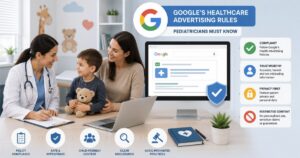
This is the part most marketing guides skip entirely and it’s the part that gets accounts suspended.
Google classifies healthcare advertising as a sensitive category, which means pediatric practices face real restrictions that a typical local business never encounters.
Key rules that apply to pediatric PPC:
- No targeting based on health conditions. Google prohibits ads that target or infer sensitive health conditions, even indirectly. You can target by location and demographics not by inferred diagnoses.
- No remarketing built on sensitive health behavior. Landing pages and remarketing lists can’t be built around a visitor’s specific medical concern.
- Most general pediatric practices don’t need LegitScript certification that’s reserved for online pharmacies, telemedicine prescribing, and addiction treatment services. A standard pediatric office advertising well-child visits and vaccinations typically falls outside that requirement.
- Claims must be evidence-based. No “miracle cure” language, no unsubstantiated outcome promises this matters especially for any vaccine- or treatment-related ad copy.
- Eligible (Limited) status is normal, not a penalty. Healthcare ads are automatically more restricted than standard local-business ads. Don’t panic if you see this status, it just means standard sensitive-category limits apply.
Bottom line: before writing a single ad, confirm your landing pages don’t collect protected health information (PHI) through forms tied to remarketing, and keep your ad copy factual rather than promotional about specific conditions or treatments.
A real-world example of how this plays out: imagine a practice runs an ad promising “guaranteed results” for a developmental concern, or sets up a remarketing list specifically targeting visitors who viewed an “ADHD evaluation” page. Both would likely trigger policy review, the first for unsubstantiated claims, the second for building audiences around inferred health conditions. The safer approach is targeting by general service category and location, then letting strong, honest ad copy do the conversion work rather than aggressive remarketing built on sensitive browsing behavior.
It’s also worth noting that Google’s healthcare policy enforcement isn’t always immediate. For most violations outside the “egregious” category (like unlicensed prescription drug sales), Google issues a warning before any suspension which gives you a window to fix ad copy or landing pages before losing account access entirely. That said, the safest strategy is never needing that warning in the first place.
How to Set Up a Pediatric PPC Campaign, Step by Step
- Create your Google Ads account and set your campaign goal to “Leads” or “Calls” not generic website traffic.
- Do keyword research before you write a single ad. Use Google Keyword Planner or a paid tool to find real search volume and CPC for your local market. Don’t guess.
- Structure ad groups by service, not by generic terms. Separate groups for “well-child visits,” “vaccinations,” “sick visits,” and “new patient pediatrician” each let you write a copy that matches intent which improves Quality Score and lowers CPC.
- Write ad copy that’s clear, compliant, and specific. Lead with what parents actually need: same-day sick visits, accepting new patients, insurance accepted. Avoid superlative health claims.
- Build a dedicated landing page for each ad group. Sending clicks to your homepage wastes budget. A landing page focused on “new patient pediatrician [city]” converts dramatically better than a generic homepage.
- Set geo-targeting tightly. Most pediatric practices should bid only within a realistic drive-time radius typically 5–15 miles, depending on your market. Read our local SEO for multiple locations guide for targeting strategy.
- Install conversion tracking before you spend a dollar. Track phone calls, form submissions, and online booking clicks. Without this, you’re optimizing blind.
- Apply negative keywords from day one. Exclude terms like “jobs,” “salary,” “free,” and any condition-specific terms outside your scope, to stop wasted clicks.
- Monitor weekly for the first month, then monthly. Adjust bids, pause underperforming keywords, and test new ad copy variants.
Best Keywords for Pediatrician Google Ads
| Keyword | Search Intent | Relative Cost |
| pediatrician near me | High immediate need | High CPC, high volume |
| pediatrician [city name] | High local, ready to book | Moderate-high CPC |
| new patient pediatrician | High actively switching/seeking | Moderate CPC |
| pediatric well child visit | Medium service-specific | Lower CPC |
| same day pediatrician appointment | High urgent | High CPC, lower volume |
| pediatric vaccinations near me | Medium-high | Moderate CPC |
Broad, generic terms like just “pediatrician” carry the highest volume and the highest competition. Long-tail, service-specific terms — “same day pediatrician appointment,” for instance usually cost less per click and convert at a higher rate, because the searcher’s intent is sharper.
Common PPC Mistakes Pediatric Practices Make
- Sending every click to the homepage instead of a service-specific landing page. A parent who clicked “same day sick visit” wants to see same-day availability immediately, not a generic welcome page they have to dig through.
- Skipping negative keywords, which lets budget leak to irrelevant searches like “pediatrician salary” or “pediatric nursing jobs.” Even a handful of these can quietly drain hundreds of dollars a month.
- Using condition-specific or promotional health claims that risk ad disapproval. Phrases implying guaranteed outcomes for a specific diagnosis are a fast path to a rejected ad.
- Setting it and forgetting it PPC needs ongoing monitoring, not a one-time setup. Search behavior shifts seasonally (flu season, back-to-school physicals), and a static campaign misses those windows.
- Ignoring mobile experience most parents search and book from their phones, often while managing a child at the same time. A slow-loading or hard-to-tap landing page costs conversions regardless of how good the ad itself is.
- too broad a radius, paying for clicks from families who’ll never actually drive that far. A pediatric visit isn’t a one-time purchase parents choose practices close enough for years of regular appointments.
The Trust-First Funnel
Most PPC guides treat pediatric ads like any other local-business ad: bid, click, convert. But pediatric care decisions carry more emotional weight than most purchases parents are choosing who they trust with their child’s health.
A framework worth building your campaign around is the Trust-First Funnel: every touchpoint, from the ad headline to the landing page, should answer one of three parent questions before asking for the click Will you see us quickly? Do you understand my child’s needs? Can I trust you? Ads built around availability (“same-day sick visits”), specificity (“now accepting newborns”), and credibility (board-certification, years in the community) consistently outperform generic “Best Pediatrician in [City]” copy, because they answer a parent’s real hesitation before asking for the click.
Agency vs. DIY: How to Decide

DIY makes sense if: you have an in-house staff member with marketing time, your market isn’t highly competitive, and you’re comfortable monitoring Google Ads weekly.
An agency makes sense if: you want campaigns live faster, you’re in a competitive metro market where Quality Score and bid strategy matter more, or your team simply doesn’t have the bandwidth to manage compliance and optimization ongoing.
Either path works. What matters most is that someone is actively managing the account tracking performance, not letting it run unattended after setup.
Conclusion
A well-planned pediatrician PPC marketing campaign can consistently generate high-quality patient leads while maximizing your advertising budget. By targeting the right keywords, creating compelling ad copy, optimizing landing pages, and monitoring key performance metrics, pediatric practices can improve appointment bookings and achieve a strong return on investment. Regular testing and optimization are essential to staying competitive and driving long-term growth in 2026.
FAQs
How much does PPC cost for a pediatrician?
Most pediatric practices spend $1,500–$4,000/month on ad spend for a focused local campaign, with a typical cost-per-click around $5.00 and cost-per-lead between $53–$78, based on 2026 healthcare benchmarks.
Is Google Ads worth it for a pediatric practice?
For most practices, yes healthcare ads convert at roughly 8% on average, well above the cross-industry rate, and PPC delivers visibility in days rather than the months SEO typically takes.
Do pediatricians need special Google certification to run ads?
Standard pediatric practices advertising routine care typically don’t need LegitScript certification that applies mainly to online pharmacies, telemedicine prescribing, and addiction treatment. Standard sensitive-category restrictions still apply, though.
What’s a good cost-per-click for healthcare ads?
Around $5.00 is the current benchmark for physicians and surgeons. If your CPC runs meaningfully higher, it’s often a sign of weak Quality Score or overly broad keyword targeting.