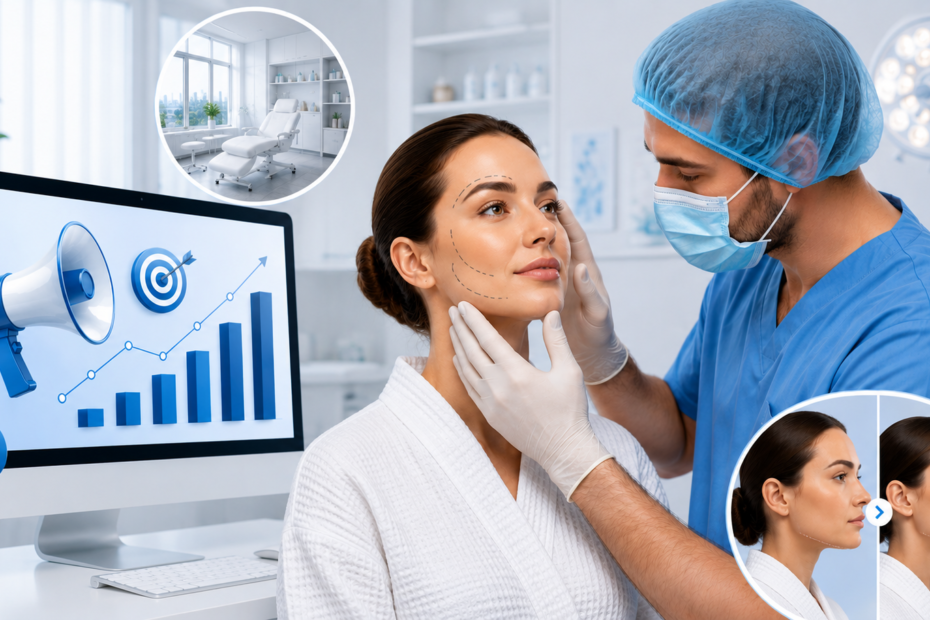
PPC for Plastic Surgeons is a powerful digital marketing strategy that helps clinics attract targeted patients through paid online ads. By using platforms like Google Ads, plastic surgeons can increase visibility, generate qualified leads, and grow their practice faster.
What Is PPC for Plastic Surgeons? (Plain English)
Forget the buzzwords. PPC stands for pay-per-click and it’s exactly what it sounds like.
You make an ad. Google shows it to people searching for your service. You pay only for clicks. Simple.
For plastic surgery practices, this means your ad can appear the moment someone searches for “best facelift surgeon near me” on Google. You skip the line. You appear above every organic result. And you only spend money on people who are actively raising their hands.
If you’re new to paid advertising and want to understand how it fits into a full digital growth strategy, our PPC Advertising services page breaks down how targeted campaigns work across Google, Facebook, and other major platforms.
How PPC Works in 60 Seconds
Think of Google as the busiest street in your city. Every search is a person walking by your storefront. PPC lets you put up a glowing sign exactly where they’re looking and pay only when they stop in.
Here’s the flow:
- You choose keywords (like “tummy tuck Miami”)
- You write an ad
- Google runs an auction every time someone searches for that keyword.
- Your ad shows up if you win.
- You pay only when someone clicks.
That’s it. No newspaper ads. No billboard guesswork. Just targeted, measurable, on-demand traffic.
Where Your Ads Actually Appear
PPC for plastic surgeons isn’t just about Google search results. Your ads can show up across:
- Google Search the top 3-4 spots above organic listings
- Google Maps when someone searches “plastic surgeon near me.”
- YouTube before or during videos about procedures
- Gmail sponsored placements inside inboxes
- Partner websites through the Google Display Network
The most valuable spot? The top of Google search results. That’s where the high-intent patients are.
Why PPC Works So Well for Plastic Surgery Practices
Most marketing channels are a guessing game. PPC isn’t. Here’s why it’s almost unfairly effective for cosmetic surgery practices.
1. Your Patients Are Already Searching
Nobody wakes up and decides to get rhinoplasty on a whim. They research. They Google. They compare. By the time they type “best rhinoplasty surgeon in [city],” they’re already 80% sold on the idea they just need a surgeon they can trust.
PPC lets you be the first name they see. And just like Google Ads for doctors and medical practices, the core principle is identical: capture the patient at peak intent, before your competitor does.
2. Each Patient Is Worth Thousands
A single rhinoplasty consultation can lead to a $10,000+ procedure. A mommy makeover? Often $20,000+. A $200 cost-per-lead suddenly looks like a steal when a converted patient pays you back 50x.
This high lifetime value is why plastic surgery PPC budgets justify themselves quickly when they’re managed correctly.
3. Local Competition Makes Geo-Targeting Lethal
Most plastic surgery patients want a surgeon within driving distance. PPC lets you target by zip code, neighborhood, or a radius around your clinic.
That means your $50 click isn’t wasted on someone two states away. It’s spent on the woman who just dropped her kids off at school three miles from your office.
4. You Can Turn It On and Off Like a Faucet
Slow month? Crank up the budget. Booked out? Pause the campaign. PPC gives you control that SEO never can.
5. The Data Is Brutal But Honest
Every click. Every call. Every consultation is booked. You see exactly where every dollar went. No more “I think the radio ad worked.” You’ll know especially when you pair PPC with proper performance analytics tracking to measure what’s actually driving bookings versus what’s just burning budget.
How Much Does PPC Cost for Plastic Surgeons in 2026?

Let’s talk numbers the real ones, not the agency-pitch ones.
PPC for plastic surgeons typically costs between $2,500 and $10,000 per month in total ad spend, depending on your market, procedure mix, and growth goals. But that’s just the headline number. The truth lives in three deeper metrics.
Average Cost Per Click (CPC) Benchmarks
The cost per click in plastic surgery is among the highest in healthcare. Why? Because the patient’s lifetime value is also among the highest.
| Keyword Type | CPC Range |
| Generic (“plastic surgeon”) | Low to medium competition keywords |
| Procedure-specific (“rhinoplasty”) | Moderate to high intent searches |
| High-intent + local (“facelift near me”) | High conversion local searches |
| Non-surgical (“Botox in [city]”) | Lower cost, high volume searches |
| Informational (“how much is a nose job”) | Early-stage research traffic |
In ultra-competitive markets like Beverly Hills, Miami, or New York City, top procedure keywords can push past $50 per click during peak season.
Average Cost Per Lead (CPL) by Procedure
Cost per click is interesting. Cost per lead is what actually matters.
A “lead” means someone who filled out your consultation form or called your clinic. Here’s what industry benchmarks look like in 2026:
| Procedure | PPC Competition Level |
| Botox / Fillers | Lower competition and high demand |
| Laser Treatments | Moderate competition with steady search volume |
| Breast Augmentation | High-intent and competitive audience |
| Rhinoplasty | Highly competitive with strong patient intent |
| Tummy Tuck | Competitive market with high-value leads |
| Facelift | Premium audience and strong conversion potential |
The healthcare industry average CPL sits around $102, with plastic and cosmetic surgery among the highest in the sector.
Recommended Monthly Budget Tiers
Here’s how to think about your budget based on practice size:
| Practice Type | Recommended PPC Approach |
| Solo practice, single location | Focus on highly targeted local campaigns |
| Established practice, one location | Expand keyword targeting and retargeting campaigns |
| Multi-surgeon or expanding practice | Use advanced PPC strategies across multiple services |
| Multi-location or aggressive growth practice | Run large-scale campaigns with ongoing optimization and tracking |
A pro tip from the trenches: anything under $2,000/month rarely generates enough data to optimize properly. You’ll be flying blind and burning cash. Start at $2,500 minimum or wait until you can.
Google’s Healthcare Ad Restrictions Every Plastic Surgeon Must Know
This is the section your competitors skipped. And it’s the one that gets practices banned from Google Ads every single week.
Google treats healthcare advertising with extreme caution. Plastic surgery sits in a tricky gray zone, and one wrong move can get your entire ad account suspended. Here’s what you actually need to know.
Why Botox & Fillers Get Your Ads Disapproved
Botox is technically a prescription medication. Google doesn’t allow advertising of prescription drugs without a special license that’s expensive and hard to qualify for.
This means:
- You can’t send Botox traffic to a page that mentions “Botox” prominently
- You can’t use the brand name in ad headlines
- You can advertise “wrinkle treatment” or “anti-aging injectables.”
- You can create separate landing pages focused on the service (not the drug)
Most practices learn this the hard way after their ads get disapproved and their account flagged. A well-structured website with compliant, conversion-focused pages is non-negotiable. If your current site isn’t built for this, our web design and development team specializes in building landing pages that are both Google-compliant and high-converting.
HIPAA Compliance in PPC Tracking (The Lawsuit Risk)
This is the one nobody talks about and it can cost you millions.
HIPAA protects patient health information. Standard Google Ads tracking can accidentally collect data that qualifies as PHI (Protected Health Information). If a user clicks an ad for “breast reduction” and Google captures their IP address, browser data, and form info, you may have just violated HIPAA.
To stay safe:
- Use HIPAA-compliant call tracking (CallRail, CallTrackingMetrics offer BAAs)
- Strip identifying data from URL parameters
- Avoid using Google’s standard remarketing pixels on procedure pages.
- Get a Business Associate Agreement (BAA) with any vendor handling patient data.
In 2023 alone, several hospital systems paid multi-million-dollar settlements for violations of tracking requirements. This isn’t theoretical it’s the fastest-growing area of healthcare litigation.
Before/After Photos What’s Allowed, What’s Not
Before-and-after images are gold for plastic surgery marketing. But Google has rules:
- Photos can appear on your landing page
- Photos can’t be used in most display or social ads
- Photos that focus on body parts (especially breasts or buttocks) often get rejected
- Face-focused before/afters are usually safe
When in doubt, go conservative. A disapproved ad is a wasted impression.
Sensitive Personalization & Why Remarketing Is Restricted
Google considers cosmetic surgery a “sensitive category.” That means standard remarketing showing ads to people who already visited your site is heavily restricted.
You can’t build an audience of “people who viewed our liposuction page” and re-target them across the web. That kind of behavioral retargeting violates Google’s sensitive personalization policies.
What you can do: use first-party data (your patient email list) with Customer Match, run YouTube ads to broad audiences, and rely on strong landing pages to convert traffic on the first visit. You can also use social media marketing to warm up audiences on Meta and Instagram without triggering Google’s sensitive category restrictions.
The Best PPC Platforms for Plastic Surgeons (Ranked)
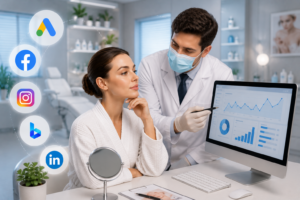
Not all platforms are equal. Here’s the honest ranking based on what actually generates consultations.
| Advertising Platform | Best For | Difficulty Level |
| Google Search Ads | High-intent patients | Medium |
| Google Local Services Ads | Local lead generation | Low |
| Performance Max | Multi-channel reach | Hard |
| YouTube Ads | Brand awareness | Medium |
| Meta Ads (Facebook/Instagram) | Awareness and retargeting | Medium |
| Microsoft Ads (Bing) | Older and affluent audience | Easy |
Google Search Ads (The Workhorse)
This is where 70% of your budget should live. High intent, high conversion, predictable performance. Someone searching “best breast augmentation surgeon Dallas” is closer to booking than 100 Facebook scrollers.
Google Local Services Ads (The Underutilized Gem)
LSAs sit at the very top of search results even above regular ads. You pay per lead, not per click. They’re hard to qualify for in healthcare niches, but if you can, they’re a goldmine.
Performance Max (The Power Tool)
Performance Max uses Google’s AI to push your ads across Search, YouTube, Gmail, Discover, and Display all from one campaign. Lower CPCs, broader reach, but less control. Works best when paired with strong audience signals and conversion data.
Meta Ads Facebook & Instagram
Meta is excellent for building awareness and showcasing your work visually (think before/afters and patient testimonial video), but leads convert more slowly than those from Google search.rch. Treat Meta as your “warming up the audience” channel. Check our social media marketing packages to see how we build Meta campaigns that complement your Google Ads spend rather than compete with it.
YouTube Ads (For Long Consideration Cycles)
Procedures like facelifts, BBLs, and mommy makeovers have long decision cycles. YouTube is perfect for educating prospects, showcasing your expertise, and staying top of mind for months.
Microsoft (Bing) Ads The Affluent Audience Bonus
Don’t sleep on Bing. Microsoft Ads typically have lower CPCs and an older, wealthier user base often a perfect demographic for higher-ticket procedures.
The Best Keywords to Target (and What to Avoid)
Your keyword strategy makes or breaks every PPC campaign for plastic surgeons. Pick the wrong words, and you’ll attract bargain hunters and tire-kickers. Pick the right ones, and your phone won’t stop ringing.
High-Intent Keyword Examples
These are the keywords where searchers are ready to book:
- “plastic surgeon near me”
- “best [procedure] surgeon in [city]”
- “[procedure] consultation [city].”
- “board-certified plastic surgeon [city]”
- “rhinoplasty specialist [city]”
- “tummy tuck surgeon [neighborhood]”
- “[procedure] before and after [city].”
- “mommy makeover [city].”
- “top facelift surgeon [city]”
- “[procedure] reviews [city].”
- “cost of [procedure] [city]”
- “Schedule plastic surgery consultation.”
- “[surgeon name] reviews”
- “[procedure] financing [city]”
- “[procedure] expert [city].”
Long-Tail Goldmines
Long-tail keywords have lower search volume but dramatically higher conversion rates and lower costs:
- “best surgeon for revision rhinoplasty in [city]”
- “non-surgical nose job [neighborhood]”
- “tummy tuck after C-section [city].”
- “natural-looking breast augmentation [city]”
- “ethnic rhinoplasty surgeon [city]”
The longer the phrase, the warmer the lead.
Negative Keywords You MUST Add
This is where most practices bleed money. Negative keywords prevent your ads from showing on irrelevant searches. Add these immediately:
- cheap
- free
- affordable (often signals discount shoppers)
- DIY
- gone wrong
- bad results
- death
- complications
- lawsuit
- school
- training
- course
- jobs
- career
- residency
- pictures
- photos (unless intentional)
- meme
- funny
- celebrity
- before pregnancy
- YouTube (unless running YouTube ads)
This single list can save you 20-40% of your wasted ad spend.
How to Set Up a Plastic Surgery PPC Campaign (Step-by-Step)
Ready to launch? Here’s the exact 8-step process that works.
Step 1 Define Your Goal
Are you chasing phone calls? Form fills? Booked consultations? Your goal dictates everything else keywords, ad copy, landing page, tracking. Don’t skip this.
Step 2 Build Your Patient Persona
Who’s your ideal patient? Age, income, neighborhood, motivation, objections. The clearer your persona, the sharper your targeting. A mommy makeover patient and a teen rhinoplasty patient need completely different ads.
Step 3 Conduct Keyword Research
Use Google Keyword Planner, Semrush, or Ahrefs. Look for patterns in procedure, intent, and location. Pull search volume, CPC estimates, and competition levels. Build a master list before launching.
Step 4 Structure Your Campaigns by Procedure
Don’t dump every procedure into one campaign. Build a separate campaign for each major service rhinoplasty, breast augmentation, facelifts, and injectables. This gives you control over budgets, bids, and messaging.
Step 5 Write Compliant, Compelling Ad Copy
Your ad has three goals: get clicked, be honest, and stay compliant. Lead with board-certified credentials, your unique angle, and a clear call-to-action. Avoid superlatives Google bans (“best in the world,” “guaranteed results”).
Step 6 Build Conversion-Focused Landing Pages
Never send PPC traffic to your homepage. Every campaign needs a dedicated landing Every campaign needs a dedicated landing page that matches the ad’s promise the same headline, the same offer, the same focus on the procedure.oals
Install Google Ads conversion tracking, set up HIPAA-compliant call tracking, and track form fills. What you can’t measure, you can’t improve.
Step 8 Launch, Monitor, Optimize
Launch with a controlled budget. Check performance daily for the first two weeks. Watch which keywords convert, pause the losers, double down on the winners. Optimization is where the real wins happen.
Real Benchmark Data: What “Good” Looks Like in 2026
Most articles talk about PPC in vague terms. Here’s exactly what good performance looks like right now.
| Metric | Typical Performance |
| Click-Through Rate (CTR) | Strong engagement and ad relevance |
| Conversion Rate | Healthy lead generation performance |
| Cost Per Click (CPC) | Varies depending on procedure and competition |
| Cost Per Lead (CPL) | Depends on surgical or non-surgical services |
| Lead-to-Consultation Rate | Indicates how many leads book consultations |
| Consultation-to-Patient Rate | Measures how many consultations become patients |
| Return on Ad Spend (ROAS) | Reflects overall campaign profitability |
If your numbers are below these benchmarks, your campaigns need work. If they’re above, you’re winning the game.
Common PPC Mistakes That Drain Plastic Surgery Budgets

After auditing hundreds of plastic surgery PPC accounts, the same mistakes keep popping up. Here are the ones costing practices the most money:
- Sending all traffic to the homepage. Generic pages convert at 1-2%. Dedicated landing pages convert at 8-15%.
- Ignoring negative keywords. This single oversight wastes 20-40% of most budgets.
- Bidding on broad match keywords without supervision. Broad match will show your ad for “plastic surgery memes” if you let it.
- Not tracking phone calls. 60% of plastic surgery leads come through phone calls. If you’re not tracking them, you’re optimizing in the dark.
- Setting and forgetting. PPC isn’t a slow cooker. It needs weekly attention especially in the first 90 days.
- Running ads 24/7. Most leads come between 7am and 11pm. Pause the dead hours and save 15-25%.
- Using the same ad copy for every procedure. Your rhinoplasty ad should look nothing like your Botox ad.
- Ignoring mobile experience. Over 70% of plastic surgery searches occur on mobile devices. If your landing page isn’t perfect on a phone, you’re losing the sale.
- Underspending. A $500/month budget can’t outperform your competition’s $5,000. Either commit or wait.
Expert Insight Lessons from Managing PPC for Cosmetic Practices
After watching hundreds of plastic surgery PPC campaigns rise and fall, certain patterns become impossible to ignore.
The Mistake 9 Out of 10 Practices Make in Month One
They obsess over cost-per-click and ignore cost-per-acquisition.
A $50 click that converts is cheaper than a $5 click that doesn’t. The practices that win are the ones that stop watching CPC like a stock ticker and start measuring what really matters: how much it costs to book a real consultation that turns into a real patient.
The Single Best Optimization Anyone Can Make
In one real-world case, a plastic surgery practice in the Southeast was paying around $308 per lead for tummy tuck campaigns. After restructuring the account with Performance Max and tightening audience targeting, the cost per lead dropped to $27 — an 11x improvement in efficiency.
The lesson? Campaign structure matters more than budget. A $3,000/month account with the right architecture will outperform a $10,000/month account with poor architecture.
What Smart Practices Do That Average Ones Don’t
The top-performing cosmetic practices share three habits:
- They answer the phone within 30 seconds. Speed-to-lead is everything.
- They measure consultation-to-patient conversion religiously not just lead volume.
- They treat their landing pages like a surgical procedure testing, refining, optimizing.
PPC isn’t a marketing channel. It’s a sales operation. The practices that treat it that way win every time.
PPC vs SEO for Plastic Surgeons Which Should You Choose?
Both are powerful. They serve different purposes.
| Speed to results | Immediate (days) | Slow (6-12 months) |
| Cost | Ongoing ad spend | Time + content investment |
| Longevity | Stops when you stop paying | Compounds over time |
| Control | High (turn on/off anytime) | Low (Google decides) |
| Scalability | Easy to scale up | Harder to scale fast |
| Best for | New launches, slow seasons, fast growth | Long-term authority, evergreen traffic |
| Risk | Budget can be wasted quickly | Algorithm updates can hurt rankings |
The smart move? Run both. PPC delivers patients today while SEO builds the moat for tomorrow. Our SEO services are designed to work alongside your paid campaigns — so both channels reinforce each other rather than compete for budget.
When to DIY vs Hire a PPC Agency
Smaller Budget
DIY management may work better, or you can wait until you are ready to invest more in advertising.
Medium Budget
You can manage campaigns yourself with proper training or hire a PPC specialist for better optimization.
Large Budget
Hiring a specialized plastic surgery PPC agency is often the best choice for scaling campaigns and maximizing results.
Very Large Budget
Consider working with a senior-level agency or building an in-house marketing team for full campaign control.
No Time for Weekly Campaign Management
Hiring an agency is the better option, regardless of your budget.
Enjoy Data and Have Time to Optimize
DIY PPC management can be realistic if you are comfortable analyzing performance and making regular updates.
Important Things to Check Before Hiring
- They have experience working with plastic surgeons
- You fully own your Google Ads account
- They use HIPAA-compliant tracking methods
- Flexible contracts without long-term lock-ins
- Transparent reporting focused on consultation bookings, not just clicks
Not sure where to start? Book a free consultancy session with our team and get a customized PPC audit for your practice with zero commitment.
Conclusion
PPC advertising allows plastic surgeons to reach potential patients at the right time with targeted campaigns and measurable results. With the right strategy, clinics can improve conversions, increase appointment bookings, and maximize their marketing return on investment. It is one of the fastest ways to grow a competitive cosmetic surgery practice online.
For more expert insights on PPC, SEO, and digital growth strategies, visit the DigitalMarketerGurus blog.
FAQs
What is the average cost per click for plastic surgery PPC?
The average cost per click for plastic surgery PPC depends on the procedure, competition, and location. Popular keywords like “rhinoplasty” are usually more competitive, while long-tail keywords such as “ethnic rhinoplasty consultation Miami” often have lower competition and better conversion rates.
How much should a plastic surgeon spend on Google Ads per month?
The monthly budget for Google Ads varies based on practice size, goals, and competition. Solo practices may start with a smaller budget, while multi-location or fast-growing clinics often invest more to increase visibility and patient leads.
Is PPC worth it for plastic surgery practices?
Yes, PPC can be highly effective for plastic surgery practices when managed correctly. It helps attract targeted patients, increase consultation bookings, and improve online visibility. Practices that combine smart PPC strategies with strong consultation processes often achieve excellent returns on their marketing efforts.
Can plastic surgeons advertise Botox on Google Ads?
Not directly. Botox is a prescription medication, so Google restricts brand-name advertising without a special license. Most practices advertise around it using terms like “wrinkle treatment” or “anti-aging injectables” and route traffic to landing pages that comply with Google’s healthcare ad policies.
How long does it take for PPC to bring patients?
Most plastic surgery PPC campaigns start generating leads within the first 1-2 weeks. Booked consultations typically begin within 30-60 days as the campaign collects data and your team optimizes targeting, ad copy, and landing pages.
What’s a good conversion rate for plastic surgery ads?
A strong plastic surgery PPC landing page should convert at 6% to 10%. Anything above 8% is excellent. If you’re below 4%, your landing page, ad-to-page alignment, or targeting needs immediate work.