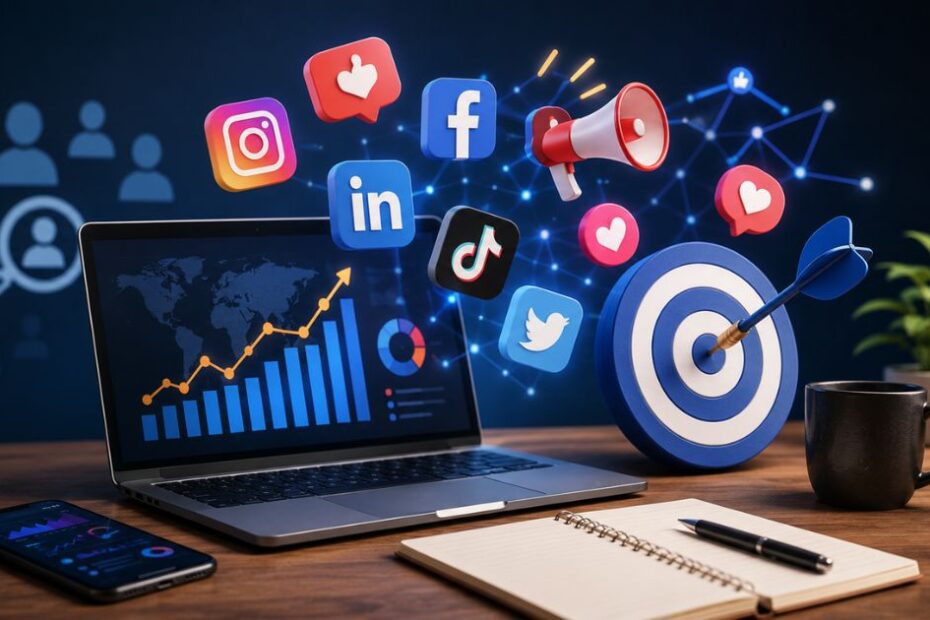
Social media marketing helps businesses grow by increasing brand visibility, driving website traffic, generating leads, and building loyal customer communities often at a fraction of traditional advertising costs. The biggest benefits include brand awareness, direct customer engagement, measurable ROI, and real-time audience insights. Most businesses begin seeing meaningful results within 3–6 months of consistent effort.
What Is Social Media Marketing?
Social media marketing (SMM) is the practice of using platforms like Facebook, Instagram, LinkedIn, TikTok, and YouTube to promote your brand, connect with your audience, and achieve business goals.
It covers two main tracks:
- Organic social content you create and publish for free (posts, reels, stories, threads)
- Paid social targeted ads you run through platforms like Meta Ads Manager or LinkedIn Campaign Manager
Most successful businesses use both. Organic builds trust and community over time. Paid amplifies what’s already working and gets you in front of new audiences faster.
At its core, SMM is about showing up where your customers already spend their time and giving them a reason to pay attention to you.
Get a Free: Social Media Strategy
Why Social Media Marketing Matters in 2026
The scale of social media isn’t a trend anymore. It’s the infrastructure of modern attention.
Here’s what the numbers look like:
- 5.24 billion people use social media worldwide as of early 2025 that’s 63.9% of the global population. (DataReportal, Global Digital Report 2025)
- The average person spends 2 hours and 21 minutes per day on social platforms. (DataReportal, 2025)
- 90% of Instagram users follow at least one business account. (Meta, 2023)
- 77% of marketers say social media marketing has been “somewhat” to “very effective” for their business. (Sprout Social Index, 2024)
- Businesses that use social media consistently generate up to 78% more business than those that don’t use it at all. (HubSpot State of Marketing, 2024)
Your customers are already there. The question is whether your business shows up.
The 12 Benefits of Social Media Marketing
1. Increases Brand Awareness
Brand awareness is the foundation everything else is built on. You can’t sell to someone who doesn’t know you exist.
Social media is one of the fastest, most cost-efficient ways to get your brand in front of a large, targeted audience. Every post, share, comment, and like extends your reach often into networks you’d never reach through traditional advertising alone.
When a customer tags your product in a story, shares your post, or simply comments on your content, their entire network sees it. That’s earned exposure you didn’t pay for.
- Stat: Consistent brand presentation across all platforms increases revenue by up to 23%. (Lucidpress, Brand Consistency Report)
- Real example: A local bakery that posts daily Instagram reels of its baking process can reach thousands of people in its city within weeks with zero ad spend.
The key is consistency. Brands that show up regularly become familiar. Familiar brands get chosen.
2. Drives Targeted Website Traffic
Social media doesn’t just build awareness it sends people to your website, where conversions actually happen.
Every post with a link, every bio URL, every “swipe up” story, and every paid ad is a bridge between your social presence and your website. And because social platforms collect detailed user data, you can target people by age, location, interests, job title, behavior, and more so the traffic you drive is far more qualified than random web visitors.
- Stat: Social media is the third-largest source of website traffic globally, behind only direct visits and organic search. (HubSpot, 2024)
- Real example: A SaaS company running LinkedIn Sponsored Content ads targeted at HR managers with 500+ employees can drive decision-makers directly to a product demo page.
Organic posts drive warm traffic. Paid ads drive targeted traffic at scale. Used together, they keep your pipeline full.
3. Generates High-Quality Leads
Lead generation is where social media starts paying for itself.
Platforms have built native lead capture tools precisely for this. Meta Lead Ads let users submit their contact details without ever leaving the app. LinkedIn Lead Gen Forms pre-fill from a user’s profile. TikTok Lead Generation ads do the same.
Beyond paid tools, organic content generates leads too through DMs, email opt-ins from link-in-bio, webinar registrations, and free resource downloads.
- Stat: 66% of marketers report that social media generates leads for their business. (HubSpot State of Marketing, 2024)
- Stat: LinkedIn is the #1 platform for B2B lead generation, with 4 out of 5 LinkedIn members driving business decisions. (LinkedIn Business, 2024)
- Real example: A financial advisor who publishes weekly LinkedIn posts on retirement planning and offers a free downloadable guide can generate dozens of qualified email leads per month entirely organically.
The quality of your leads depends on the quality of your content and how well you understand your audience. Solve their real problems, and they’ll raise their hand.
4. Boosts Customer Engagement
Engagement is the metric that turns casual scrollers into loyal customers.
Unlike a billboard or a TV ad, social media is a two-way channel. You can respond to comments, answer DMs, run polls, host Q&As, and actually have conversations with the people who buy from you.
This level of direct access used to be reserved for massive brands with huge customer service teams. Now a solo entrepreneur can build the same kind of relationship with their audience one reply at a time.
- Stat: Brands that engage on social media see a 20–40% increase in spending from their engaged customers compared to non-engaged ones. (Bain & Company)
- Real example: Wendy’s famously built a massive social following (and drove real sales) by being witty and responsive on X (formerly Twitter). Small businesses can do the same with genuine, consistent replies.
High engagement also signals to platform algorithms that your content is worth showing to more people creating a compounding reach effect over time.
5. Builds Community and Brand Loyalty
Customers who feel connected to a brand don’t just buy once they come back, refer friends, and defend you publicly.
Social media is the most accessible tool ever created for building a community around your brand. Facebook Groups, LinkedIn communities, Instagram close friends lists, Discord servers these are spaces where your most loyal customers gather, share, and advocate for you.
A community is a compounding asset. Every new member makes the community more valuable, which attracts more members, which builds more loyalty.
- Stat: 76% of consumers say they’d buy from a brand they feel connected to over a competitor. (Sprout Social Index, 2024)
- Real example: LEGO’s online community built significantly through social generates customer-created designs that LEGO then produces commercially. The community creates value for the brand and for itself.
You don’t need a massive budget to build a community. You need consistency, genuine engagement, and a clear reason for people to belong.
6. Provides a Cost-Effective Marketing Channel
Social media has the lowest barrier to entry of any marketing channel at scale.
Creating a business profile on Facebook, Instagram, LinkedIn, or TikTok costs nothing. Publishing organic content costs your time. Even paid social advertising lets you start with budgets as low as $5–$10 per day and scale only when results justify it.
Compare that to traditional advertising:
| Channel | Average Cost to Reach 1,000 People (CPM) |
| TV advertising | $20–$30 |
| Print advertising | $15–$20 |
| Billboard | $5–$10 |
| Facebook / Instagram Ads | $5–$10 |
| TikTok Ads | $3–$8 |
| LinkedIn Ads | $20–$50 (higher cost, higher B2B intent) |
(Sources: Nielsen, WordStream, LinkedIn Marketing, 2024 estimates)
For small businesses especially, organic social content combined with modest paid promotion can outperform much larger traditional advertising budgets if the content is good and the targeting is sharp.
7. Delivers Measurable ROI
One of the oldest criticisms of marketing was “I know half my advertising works I just don’t know which half.”
Social media solved that.
Every platform gives you native analytics: reach, impressions, clicks, conversions, cost per result, and more. Third-party tools like Google Analytics, Sprout Social, and HubSpot layer on attribution data so you can trace a sale back to the exact post, ad, or campaign that started the journey.
- Stat: Social media advertising delivers an average ROI of $2.80 for every $1 spent. (Statista, Digital Advertising ROI Report, 2024)
- Stat: 83% of marketers say they can demonstrate the ROI of their social media activity. (Sprout Social Index, 2024)
The formula for measuring social media ROI:
(Revenue Generated − Total Costs) ÷ Total Costs × 100 = ROI %
“Total costs” includes ad spend, content creation time, tool subscriptions, and agency fees. The more precisely you track, the more confidently you can reinvest.
8. Unlocks Deep Audience Insights
Social media is the largest ongoing focus group in human history and it’s free to observe.
Every platform gives you demographic and behavioral data about your audience: who they are, where they live, what content they engage with, when they’re online, and what they respond to.
Meta Business Suite, LinkedIn Analytics, TikTok Analytics, and YouTube Studio all offer this natively. Tools like Sprout Social and Hootsuite aggregate it across platforms.
But the real gold is social listening monitoring conversations, hashtags, and mentions to understand what your audience actually thinks, feels, and needs, often before they’d ever say it in a survey.
- Real example: A skincare brand notices through Instagram comments that customers keep asking about a SPF moisturizer they don’t make. They launch one. It becomes their best-selling product within 90 days.
This kind of real-time, unsolicited customer feedback used to cost tens of thousands in market research. Now it’s a few hours of listening per week.
9. Amplifies Content Reach
Every piece of content you create has more potential on social media than almost anywhere else.
A blog post you publish on your website reaches whoever finds it via search. That same post shared on LinkedIn with a personal insight, repurposed into an Instagram carousel, turned into a 60-second TikTok can reach ten times the audience.
Social media is a content distribution engine. It multiplies the return on everything you create.
The platforms also reward good content with algorithmic amplification. A post that gets strong early engagement gets pushed to a wider audience automatically giving you reach beyond your existing followers at zero extra cost.
- Stat: Content shared on social media gets 3x more engagement than content distributed through other digital channels. (BuzzSumo Content Trends Report, 2024)
- Practical tip: Build a repurposing workflow. One long-form piece of content (video, blog, podcast) should generate 5–10 social posts across platforms. This is how you scale content without burning out.
10. Builds Social Proof and Trust
People trust people more than they trust brands.
Social proof reviews, testimonials, user-generated content (UGC), and public engagement numbers is one of the most powerful conversion tools in marketing. And social media is where social proof lives.
When a potential customer sees that your product has 4,000 Instagram comments, that real people are posting unboxing videos, or that your LinkedIn page is full of genuine recommendations their purchase hesitation drops significantly.
- Stat: 93% of consumers say online reviews and social proof influence their purchasing decisions. (PowerReviews, 2024)
- Stat: User-generated content is 2.4x more likely to be seen as authentic compared to brand-created content. (Stackla/Nosto, Consumer Content Report)
- Real example: Fashion brand ASOS built a massive revenue stream by featuring real customers wearing their clothes on social media a “See My Fit” UGC campaign that drove more conversions than their own product photos.
Encourage reviews, reshare customer content, and make it easy for happy customers to talk about you publicly. Social proof compounds over time.
11. Gives You Competitive Intelligence
Your competitors are showing you their strategy every day for free.
Their social feeds tell you what content they’re investing in, which products they’re promoting, how their customers respond, what complaints keep surfacing, and where they have gaps you could fill.
This is competitive intelligence that once required expensive research firms. Now you need 20 minutes and a notebook.
- What to watch for:
- Which of their posts get the most engagement (and why)
- What their customers are complaining about in comments
- Which ad creatives they’re running (visible via Meta Ad Library a free public tool)
- What topics they never address those are your content opportunities
- Tool tip: The Meta Ad Library (facebook.com/ads/library) lets you see every active ad any brand is running on Facebook and Instagram. It’s free, public, and criminally underused.
Use your competitors’ social presence as a permanent research briefing. They’re doing your market research for you.
12. Supports Customer Service at Scale
Customers now reach out to brands on social media before they pick up the phone or send an email.
This is a shift you can use to your advantage. Brands that respond quickly and helpfully on social media build a public reputation for great service because every response is visible to everyone.
- Stat: 79% of customers expect a response from brands on social media within 24 hours. (Sprout Social Index, 2024)
- Stat: Brands that respond to customer service requests on social see 20–40% higher customer spend from those customers. (Bain & Company)
- Real example: JetBlue built one of the strongest airline loyalty followings by responding to X (Twitter) complaints publicly, quickly, and with genuine solutions turning frustrated customers into vocal advocates.
You don’t need a dedicated social care team to do this well. A simple system daily monitoring, a bank of response templates, and a commitment to replying within a few hours is enough to outperform most competitors.
Benefits of Social Media Marketing for Small Businesses
Small businesses often get more from social media, proportionally, than large ones.
Here’s why: authenticity scales better at small sizes. A local coffee shop owner who posts daily behind-the-scenes content connects with their community in a way a national chain simply can’t replicate. The “local face” is a competitive advantage.
Small businesses also benefit from lower competition within local or niche audiences. Getting 5,000 highly engaged local followers can drive more revenue than getting 500,000 passive national ones.
Which Platform Is Best for Your Business Type?
| Business Type | Best Platform(s) | Primary Benefit |
| Local retail / food / services | Facebook, Instagram | Community reach, local awareness |
| E-commerce / DTC brands | Instagram, TikTok, Pinterest | Product discovery, UGC, shopping features |
| B2B / professional services | Lead generation, thought leadership | |
| Creative / visual brands | Instagram, Pinterest, TikTok | Brand aesthetic, content amplification |
| Tech / SaaS | LinkedIn, X (Twitter) | Industry authority, community |
| Education / coaching | YouTube, Instagram, TikTok | Content trust, lead nurturing |
The rule of thumb: Start with the platform where your specific customers already spend time. Master one platform before expanding to two.
B2B vs. B2C Does It Change?
For B2C brands, social media drives awareness, purchase intent, and community. Emotional content, visual storytelling, and UGC do the heavy lifting.
For B2B brands, social media especially LinkedIn drives thought leadership, pipeline, and recruitment. Long-form posts, data-driven content, and executive personal brands are the primary vehicles.
Both benefit from social media. They just use different platforms, content formats, and success metrics.
Social Media Marketing vs. Traditional Marketing

| Factor | Social Media Marketing | Traditional Marketing |
| Cost | Low to moderate (free to start) | High (print, TV, radio) |
| Targeting | Precise (demographic, behavioral, interest) | Broad (geography, time slot) |
| Measurability | High (real-time analytics) | Low (difficult to attribute) |
| Reach | Global or hyper-local | Primarily local/regional |
| Speed | Immediate (post live in minutes) | Slow (production + placement lead times) |
| Two-way communication | Yes | No |
| Content lifespan | Short (hours to days organically) | Longer (billboards, print) |
| Best for | Awareness, engagement, leads, loyalty | Mass awareness, older demographics |
The most effective marketing strategies use both traditional for broad reach and brand legitimacy, social for engagement, targeting, and measurable conversion.
How Long Does Social Media Marketing Take to Work?
This is the most honest answer you’ll find: it depends on your goal.
| Goal | Realistic Timeline |
| Brand awareness (reach) | 1–3 months of consistent posting |
| Meaningful engagement | 2–4 months |
| Steady organic traffic | 3–6 months |
| Qualified leads from organic | 4–8 months |
| Positive paid ad ROI | 1–4 weeks (with testing budget) |
| Community with real loyalty | 6–18 months |
Here’s what a realistic organic growth timeline looks like:
Months 1–2: Set up profiles, establish your content voice, post consistently (3–5x per week), test different formats. Focus on learning, not results.
Months 3–4: Analyze what’s resonating. Double down on top-performing content types. Start seeing follower growth and early engagement upticks.
Months 5–6: Consistent traffic, engagement, and early lead signals. The algorithm begins recognizing your account as active and valuable. Reach expands.
Month 6+: Compounding returns. Your audience is growing, your content library is working for you, and results become more predictable.
The biggest mistake marketers make is expecting results in weeks and quitting in month two. Social media is a compounding channel the longer you stay consistent, the steeper the return curve gets.
What Are the Challenges of Social Media Marketing?

No honest guide skips this part. Social media marketing is genuinely valuable and genuinely hard. Here’s what you’re signing up for:
1. It takes real time.
Creating good content, engaging with your audience, monitoring analytics, and staying current with platform changes is a minimum of 5–10 hours per week for a small business. More if you’re running ads.
2. Algorithms change without warning.
What worked last quarter may not work this quarter. Platform updates like Instagram deprioritizing static posts or LinkedIn changing feed ranking can cut your reach overnight. You never fully own your social audience.
3. Negative comments are public.
One bad review, one viral complaint, one tone-deaf post can undo months of goodwill publicly. You need a crisis response plan and the emotional resilience to handle public criticism professionally.
4. Content fatigue is real.
Audiences want fresh, original content constantly. The demand for new ideas never stops. Burnout among social media managers is a documented, serious problem.
5. Results aren’t guaranteed.
Well-structured, consistent, quality social media marketing raises the probability of results but doesn’t guarantee them. Niche, competition, budget, and execution quality all determine outcomes.
The counterpoint: Every one of these challenges is manageable with the right system, team, and expectations. The businesses that win on social media are the ones that treat it as a long-term investment, not a quick fix.
How to Get Started with Social Media Marketing
You don’t need a massive budget or a full marketing team. You need a clear system.
Step 1: Choose the right platform.
Don’t try to be everywhere. Start where your customers already are. (Use the platform table above as your guide.) Master one platform before adding a second.
Step 2: Set specific, measurable goals.
“Get more followers” isn’t a goal. “Generate 50 qualified leads per month from LinkedIn within 6 months” is. Tie your goals to business outcomes traffic, leads, sales, retention.
Step 3: Build a simple content plan.
Decide what you’ll post, how often, and what format. A realistic beginner cadence: 3 posts per week, one content pillar per week (educational, promotional, community). Batch-create content so you’re never scrambling.
Step 4: Post consistently and engage daily.
Consistency beats perfection. A good post 3x per week outperforms a perfect post once a month. Spend 15–20 minutes per day responding to comments and DMs. Engagement drives algorithmic reach.
Step 5: Measure, learn, and adjust monthly.
At the end of each month, review your analytics. What got the most reach? The most engagement? The most clicks? Do more of what worked. Cut what didn’t. Iterate every 30 days.
Conclusion
Social media marketing offers far more than increased visibility—it helps businesses build trust, engage customers, generate qualified leads, and drive long-term growth. While the benefits are significant, success requires a clear strategy, consistent content, audience engagement, and ongoing performance analysis. By understanding both the advantages and the challenges, businesses can maximize their return on investment and create a sustainable social media presence.
Contact Our: Experts Today
FAQs
What are the biggest benefits of social media marketing for small businesses?
For small businesses, the most impactful benefits are low-cost brand awareness, direct community building, and the ability to compete with larger brands through authentic content and engagement. Local businesses in particular can build hyper-targeted audiences of potential customers at near-zero cost with consistent organic posting.
What is a good ROI for social media marketing?
A commonly cited benchmark is a 3:1 return $3 in revenue for every $1 spent. However, ROI varies significantly by industry, platform, and campaign type. Paid social campaigns can show positive ROI within weeks; organic content typically takes 3–6 months before generating measurable revenue return.
Which social media platform is best for marketing?
There’s no single best platform it depends on your business type and audience. Instagram and TikTok excel for visual, B2C brands. LinkedIn is the gold standard for B2B lead generation. Facebook offers the broadest demographic reach. YouTube drives long-term authority through video. Start with the platform your specific customers use most.
How much does social media marketing cost?
Organic social media marketing costs your time anywhere from 5 to 20+ hours per week depending on your output goals. Paid socials can start as low as $5–$10 per day. A realistic budget for a small business running a basic paid strategy is $500–$2,000 per month. Agencies typically charge $1,000–$10,000+ per month for full management.
Is social media marketing better than traditional marketing?
For targeting precision, measurability, two-way engagement, and cost efficiency, social media marketing typically outperforms traditional marketing. For broad mass-market awareness and reaching older demographics, traditional channels still have a role. Most effective strategies combine both traditional for reach and credibility, social for engagement and conversion.